Thursday, October 20, 2011
The Good Doctor's Portrait
Geez, it seems like another lifetime ago when I last posted, but now that the nights are longer, it should be easier to find the time. I wonder if I'll miss the sun. I haven't had time to blog because I've been super busy working on a portrait commission of a new arrival in town. He's a Doctor of Hematology by the name of Acula. He bought an old mansion in the center of Pittston Village named Marston Manor. The manor has seen better days since it was originally built back in the late nineteenth century, as today it's run-down and creaky with crooked shutters hanging askew next to broken windows. He said he has plans on restoring it to it's former glory so that, as he put it in his wicked cool, vaguely European accent- "everyone will fit".
The Doctor said he saw my work on-line, (so, that's a good reason to have a web site!) and asked me if I could paint his portrait. I thought it was a wonderful gesture to ingratiate himself to his new neighbors. I was expecting for him to hand me a photo to work from, but as he said he takes a lousy photo, he requested I do it from life. The only rub was that I had to work on it at night because he's not available during the day. Not a problem. There's nothing on TV at night anyway since the Red Sox blew the season. The manor is only a short walk across my lawn, so early one evening I grabbed my gear and headed over.
We set up that first night in what was once an elegant front parlor. It has an amazing fireplace with an eight foot tall granite mantle topped by a huge beveled mirror. The mirror was covered up to prevent any damage during construction. The only light came from one naked bulb that hung down from the cracked, sagging ceiling in an area that apparently had a chandelier at one time. Bad light, but hey-- you deal with it. The Doctor has a remarkable face with intriguing features that I was certain would be fun to paint. He's about sixty-five or so, although he says he looks younger than he really is. He still has an amazingly thick head of jet-black hair swept-back from his intelligent looking forehead with just a touch of gray at his temples. It's quite old fashioned, yet aristocratic. To a follicle-challenged type like me, I was quite envious. His face is long and lean with high, prominent cheek bones, and an elegant, aqualine nose. His mouth is somewhat wide with bright white teeth, but what got me was his eyes. I couldn't quite figure out what color they were. At times they seemed blue, then gray, then maybe silver. All I could do was stare and stare and stare.
I worked pretty hard that first session, so much so that I hardly realized the night had flown by. The only thing I remember was hearing all kinds of strange noises coming from the cellar, but Acula said it was to be expected that animals would get into an old building like his. After a couple of days my beautiful partner Ellen noticed how lethargic I had become. More so than usual for me! She pointed out that my complexion was looking rather pasty, and my lips looked almost blue. I did feel extremely tired and it seemed I just couldn't get myself going during the day. I blamed it on keeping late hours while I was working on the portrait. That probably was the case, because after the second week, I was sleeping through the whole day. After the sun was fully set, I would feel much better and be ready to get back at it. I did become aware of strange little quirks in my home life. After a couple of weeks, I noticed my dog Champ was acting rather oddly around me; snarling and growling when I'd get up for the night. I wanted to ask Ellen if he did the same thing to her, but she was no where to be found. Come to think of it, I couldn't remember when I had last seen her. And damn, was I thirsty. Acula said the thirst was to be expected. I guess dusty old buildings can have an odd affect on you.
I thought the portrait was coming along alright--but damn, those eyes. The good thing was that the Doctor was a very engaging man. I discovered we both have an affinity for history. Acula would regale me with lively and entertaining stories of centuries past, told in such a way as to make me almost believe he lived through them. His stories almost kept me from noticing the noises coming from the basement. The sounds of shuffling feet, low guttural grunts and squeals did disrupt my concentration from time to time. I asked the Doctor if he was going to do anything about getting rid of whatever was down there, but he just gave me one of his slight, quixotic smiles and said he wasn't bothered by it at all. I guess after a while, it didn't bother me either.
As I was walking to the Doctors during this past full moon I noticed our neighbors, Harry and Jean coming from the direction of the manor, looking like two ghosts glowing in the moon light. I hadn't seen them since early spring when we celebrated Harry's eightieth birthday. Jean is seventy-nine and used a wheelchair and oxygen pack, so as I remember, we kept the candles to a minimum! This night I noticed they were both running across a meadow toward a horse that was grazing there. The startled animal ran frantically away from them, but was soon cornered against a fence. It reared up and slashed its hooves at Harry, who ducked and bobbed under them with lightning speed. The horse's terrified baying and whinnying sounded like a woman's screams as Jean clawed at its stomach with her long, pointed finger nails. Then both Harry and Jean jumped up on the horse and by savagely ripping and chewing it's neck brought it down in a shrieking heap of dirt, kicking legs and blood. I thought the silver light sparkled beautifully on their gray hair and flashing teeth as the sounds of gnawing and slurping filled the air. Eventually, the horse lay still. Made me pretty damn hungry.
The other night I was in the manor working on the painting, and I felt it just wasn't coming together. The eyes...the eyes... Something was gnawing at me, but I couldn't for the life of me figure out what it was, so I decided to use my mirror trick. If you've never tried it, looking at a painting through the reflection of a mirror really helps you see with new eyes what is wrong with the work. In my studio I have a mirror on the opposite wall behind me for just that purpose, but I wasn't in my studio. When Acula was in another room, I went over to the huge mirror that was covered up over the fireplace mantle. I adjusted my easel to see the painting, then peeled back a corner of the covering to see the reflection.
All I saw was a blank canvas.
As I was puzzling over my blank painting, I heard footsteps come up behind me, but nothing showed in the mirror. I turned around and saw Dr. Acula standing beside the painting and gazing fondly at it. "My young artist friend," he said in his silky voice, "No need to fret so, you've done excellent work on my portrait. It is exactly like me in every particular! I've an idea," he continued, "We must have a grand showing of this masterpiece, and I am sure all of your neighbors will be delighted for you to join them!" With that, he tipped his head back and started to laugh. It started out as a low bass note that seemed to eminate from every room in the house, then changed pitch until it became a piercing whistle that stabbed my ears like ice picks. Just when I thought I couldn't stand anymore, every door in the ancient house blew open. Then I saw them as they shambled into the parlor.
They were all of my neighbors; Harry and Jean, George and Mary Ellen, Dan and Leyla, Vicky and Sue-- and others I didn't know that well. Dozens of them. Their clothes were torn, dirty and encrusted in dried blood. Hair was matted and scraggly. Even my beautiful Ellen was with them, one lone earing flashing a reflection from the light bulb swinging overhead. She was holding Champs empty dog collar and his fur covered her torn black T-shirt. But worst of all was that they were smiling. It was the type of smile a starving man might have when he finally spies some food. They slowly made their way across the room toward me.
"Yes," Dr. Acula continued, "Your friends would love for you to join them forever in the night."
"I'd be thrilled" I gushed, "But do you all think we could hold off until the 31st? You know, we could even make it a party. After all--
I love Halloween!"
.
Tuesday, October 4, 2011
Where The Turkeys Roam
This week marks the one year anniversary of Maine-ly Painting! Hard to believe, but just 52 weeks ago I set out to write a blog that employed useful painting tips with deep insight into the world of art and artists. Trust me, I'm gonna get around to doing that some time real soon, but for now, this is just one of my usual posts.
For some, autumn is their favorite season. The days are crisp and clear, with the heat and haze of summer in the rear-view mirror. Here in Maine, as in the rest of New England, autumn also means beautiful fall foliage. Except this year. Last month hurricane Irene blew through dumping copious amounts of rain and gusty winds that just completely stressed out the trees. What was a deep green canopy shriveled into a curled up brown and ochre smear. It has all the color and brilliance of some old 1940's Orson Wells flick. But I set out to paint it anyway.
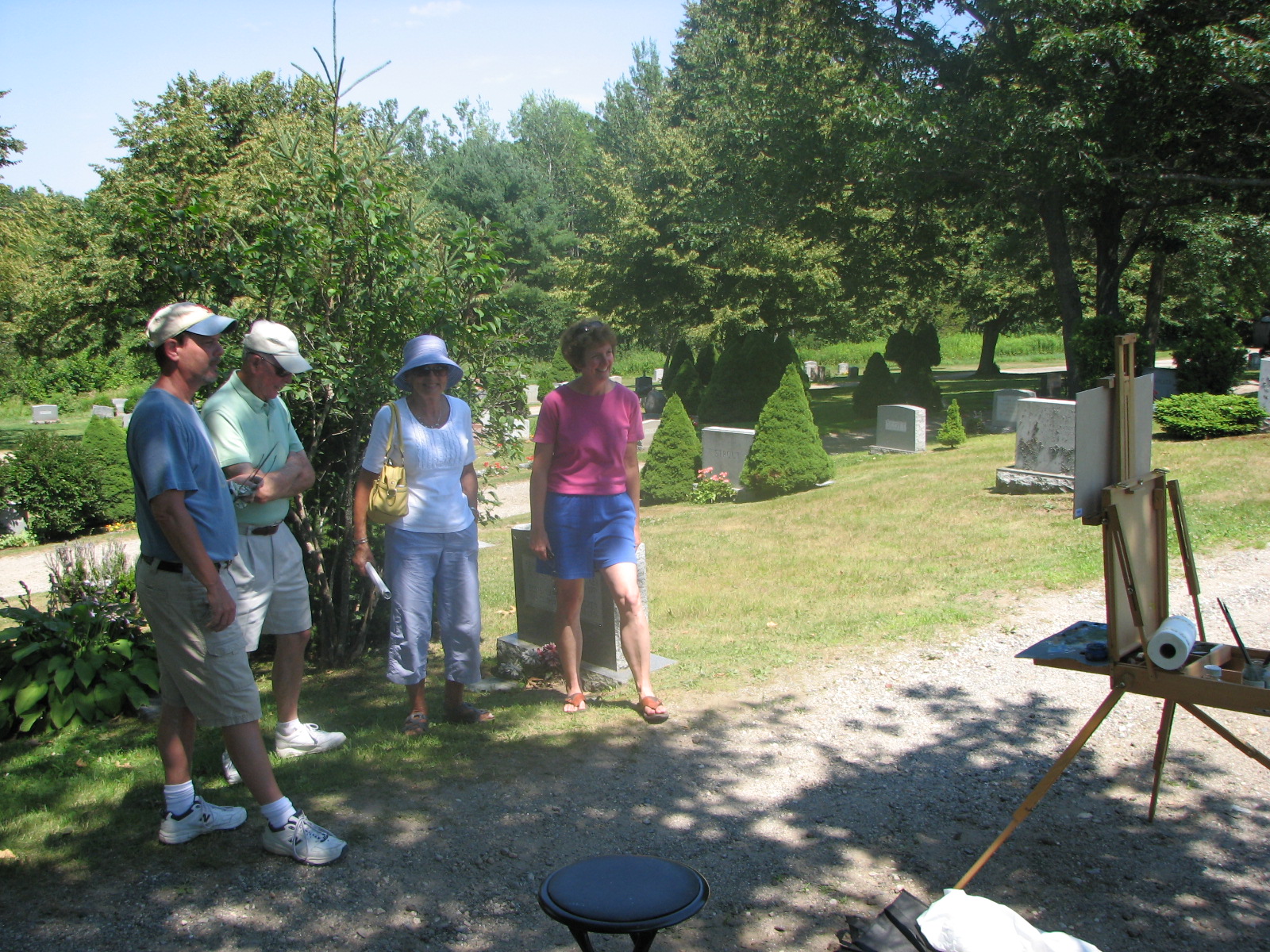
Last week I set up in a lovely old cemetery in Dresden, Maine and painted the view. I like cemeteries. I enjoy reading the tombstones and trying to envision the life these folks once lived. Young ladies with their date of death coinciding with the birthday of their last child tell a sad story. There were also too many stones marking the resting place of an infant. It was a hard life back in the day. But there's also a large number of folks who lived well into their eighties and nineties. It seems like if you made it through childhood, you had a great chance to live a long life.
Cemeteries were also set up on top of hills that at one time afforded a lovely, peaceful view, but now only overlook highways, shopping centers or condos. But this particular cemetery still has a vestige of what once was. It has some stately maples crowning it's crest and it overlooks some old farms that have been there for over one hundred years.
I've blathered about my painting technique on previous posts, so I'll spare you the particulars, but I wanted to show the light of early morning on the fields and farms. That meant getting my butt up and out of the house early enough to be set up and record the sight. I am not a fan of morning. Years ago, when I was still punching the clock, I had jobs that required me to be on the job at three in the morning. That's right-- three in the freaking morning! I swore then that I wouldn't mind if I never saw another sun rise for the rest of my life. I've gotten over it, but I'm still not a up-and-at-'em kind of guy. Luckily for me, though, is that sunrise this time of year isn't nearly as early as in the middle of summer.
I had some visitors while I was working on site. A lovely lady and her grand daughter take morning walks there and stopped by to chat. The older lady asked me why I wanted to paint that view? It was a matter of perspective; here I was intent on painting barns and fields, and all she saw was someones back yard.
I also had some turkeys saunter on up to check me out. Apparently, they know a distant relative when they see one...
The fall colors never really did pop, as I had hoped, but there's always next year. Another winter, spring and summer to get through, but also another year of Maine-ly Painting!
.
Monday, September 19, 2011
The Thrill Of Experience
I was visiting a local art gallery recently, something I love to do, when I stumbled upon a painting that stopped me in my tracks; The artist had depicted a lobsterman in an un-natural act. He (the lobsterman) was depicted leaning over the rail of his boat, reaching down to grab the spindle of his lobster buoy. Now, far be it from me to disparage someones painting--and it wasn't bad, it had pretty colors and everything-- but the painter had no clue about lobstering and it showed. For starters, a lobsterman never leans out below the side of his boat. One ill-timed wave, and he is treading water in heavy rubber boots and stiff polypropylene bib. Instead, he uses a long stick with a hook on the end, called a gaff to hook the line under the buoy. The artist also depicted the lobsterman in some form of craft that bore no resemblance to an actual lobster boat. Now before you think of me as some stuck-up know it all, (I'm not stuck-up!) I do know of what I speak: I used to work on a lobster boat.
Ah, the things we do for art... several years ago when I lived on the coast of Maine in Cundy's Harbor, I signed up to work on the Mary Ellen II, a beautiful lobster boat run by a great guy named Charlie Saunders. I wanted to do the work to get as much insight and experience as I could for future use in my paintings. A lot of folks paint lobstering scenes from a distance. You know, pretty white boats bobbing about on a beautiful blue ocean on a gorgeous summer day. I wanted to depict it from the lobsterman's point of view. (An idea I still think has some merit). So, to be accurate in my portrayal of the lobstering industry, and get some good painting ideas, for the lobstering season of 2007, I went to sea.
The first thing one needs to know about lobstering is: it's damn hard work! Everyday was an eight hour workout on a pitching, rolling gym. Lobster traps only weigh about thirty pounds, but we hauled two hundred and forty or so a day, so after awhile, they felt a lot heavier than that. I was loading the traps on board one day early in the season when I wrenched my back so bad I could barely walk. Here's what you do when that happens-- you keep working.
The operation goes like this; the Captain pulls the boat alongside a buoy that marks his "string" of traps-- anywhere from two traps to ten on a continuous line. (We had five on a string), he pulls them aboard and starts taking out the "keepers"-- lobsters of legal size. My job was to pull out and measure the lobsters too, then re-bait the trap, put the trap on a plank called the "trap rack" that ran down the center of the boat, put rubber bands on the claws of the lobsters to keep them from eating each other, re-fill the mesh bags that held the smelly bait, and avoid getting caught up in miles of line snaking under my boots. The Captain then dropped the string back to go catch more lobster, and headed off to find another string. Over and over and over again... More than once I had a large, pissed off lobster clamp down on my hand with his crusher claw as I tried to band him. Here's what you do when that happens-- you keep working.
The wire-mesh traps are easy to grab and toss about, but I tore a tendon in one of my fingers from the constant pull and strain against my knuckles. I've had regular cortisone shots to loosen it up, but to this day I still can't close my right hand enough to make a fist. Here's what I did when that happened-- I kept working.
The bait we used was herring. It was preserved by salt, an age-old way of preserving dead fish. We would pick up a few hundred pounds of "fresh" bait in the morning, but by mid-day it was far from lively. The stench was bad, but the liquid of decomposing fish flesh that would pool in the trays the bait was in was worse. It would splatter on my face, squirt into my eyes, and flick up into my mouth. Tiny fish bones dripping with this goo would pierce my gloves and inject itself into my fingers and hands. The result is getting something called bait poisoning, and I had it several times that year. Here's what you do when your fingers are painfully red, swollen and infected-- you keep working.
The season dragged slowly along, summer shifted into fall, and along with the change of seasons came autumn storms. I have never been one to get sea-sick, but I was laid pretty damn low when ten foot swells tossed our boat about in the month of November. What do you do when you're fifteen miles out to sea with a pounding headache, tumbling stomach, rubbery legs and generally feeling sick as a dog? Need I say? You keep working.
I do have some fond memories. I've seen whales, porpoises and schools of tuna dancing in the waves. I've seen lobsters larger than you could imagine. I've witnessed all kinds of spectacular weather effects. And I did take thousands of photos while I was out there. The ocean is a beautiful, lively being, and I studied it every day from a seat in a classroom that only Mother Nature could provide. I have tried to show my respect for all of those in the lobstering industry by being as accurate as I can be in my paintings.
Maybe some time in the future I can do paintings of the fabulously wealthy. Should be fun to research-- after all, I do like to get first hand knowledge before I paint. And besides, while I'm not positive, I doubt they'll give me bait poisoning.
.
Tuesday, September 6, 2011
Whatever It Takes
Like you, I get asked questions every day; "Paper or plastic?"... "Do you want fries with that?"... "May I see your license and registration please?" Sometimes I get asked, "How did you paint that?" To which I answer, "Well Mom, it's complicated..."
I don't know about you, but I always enjoy reading about how other painters go about their business in making pictures. So, on the possibility that you might be interested in how this painting, North Side came about (a slim possibility, I admit), here's what I prefer to do to come up with a painting.
First, I got inspired. Now, I've seen this view every day for a couple of years, because I live here. This vantage point is from behind my studio, looking up the slope past my garage to the side porch of my house. It may not be a particularly thrilling view, but I was more intrigued by the inter-play of color temperatures than from the architectural elements. But that's what usually grabs me- not the thing, but how it's lit up.
Next, I stood out there and drew the scene.
In this case I used a masonite panel, which is my preferred painting support because I can be more detailed with it than I can be with canvas. I have used up countless precious internet space complaining about photographs, and this is why I didn't want to use one; not that the colors would be messed up (because they will be), but because the perspective would be skewed. So I took extra care in making sure I put everything in its proper perspective and spacial arrangement. Then, I used a photo to finish the underdrawing. Why? Because then I could finish the drawing in the studio using the photo for details, while disregarding its false perspective. And yeah, I counted each and every clapboard on my garage...
Then came some layers of underpainting.
I usually build up my pictures with glazes. I like the richness and depth that they impart on a piece, as opposed to direct painting. For instance, I glazed warm tones over the shadow areas of the garage, which has a cool light, and cool colors over the grass which are the result of warm sunlight. This was done with Liquin Fine Detail medium, which dries quickly. I wanted to glaze and block in as much as I could so that all I had to worry about when I went back outside was color. This shows the picture about half-way through that process.
So, when I was happy with all that, back outside I went.
I spent two days outside working on the final color application, I don't know- maybe ten hours total. I thought the time around 10:30 and noon gave me the best color and light, so I worked on the areas that were directly involved in sun during those times, and the other sections before and after then. I think it's an important point that I didn't chase the light. My design was already thought out, the shadows were going to be as I already placed them; I used direct observation for color, not detail. And doing all that prep work meant I didn't have to worry about drawing because I'd already done that. (I'm not saying that the painting process was just coloring between the lines, but that I didn't think about where to put the window, or what size to make the porch, because that was already determined). Okay, not the most spontaneous way of approaching a picture, I'll grant you, but it's worked for me.
So there you have it, a smorgasbord of studio, plein air, Rube Goldberg method of painting. I think of it as the "whatever it takes" technique. If you have a more convoluted method, don't make me ask, I'd love to know!
.
Thursday, September 1, 2011
Swingin' For The Fences
Ted Williams, arguably Baseball's greatest hitter-- even if he did say so himself-- said that the key to being a good hitter was, "get a good pitch to hit". Sage advice, but easier said than done. Many has been a big-league hitter who looked like an idiot swinging at pitches in the dirt. They thought they had a good pitch to hit, only to be badly fooled. Then there's Joltin' Joe DiMaggio, who once said that the difference between a warning track fly ball and a home run was the difference of just one quarter-inch of where the ball hit the bat.
What's my point? Well, isn't painting like that? You know, getting a good subject to paint is like getting a good pitch to hit. Maybe it's a babbling brook flowing through a lovely meadow, or a vase of peonies, or perhaps a lovely model reclining on a Victorian couch that screams "Paint Me!" the way a hanging slider screams "Hit Me!" to a baseball player. But then comes the rub: is it going to be a pop-up, or a home-run?
Take that stream, for instance. Would it be a better composition from this side, or that side? And that flowering apple tree in the meadow; how do I incorporate that? What about those lovely flowers in that stoneware vase-- might it be more interesting with a cut-glass crystal vase? Oh, and let's not forget that lovely model; should I show one breast or two? It's those little details that make or break a painting. The great painters seem to make the right decisions and hit it out of the park, while the rest of us hit grounders up the middle. Sure, it might be a hit, but it's not a Home-Run.
I don't want to forget about those insidious subjects that look like they would make a great painting, a masterpiece that will hang in the Louvre someday, only to really be a fifty-nine foot curve-ball that you swing at and miss for strike three. How do you keep from chasing bad pitches? Practice, practice, practice, so the next time you see a "Hit Me!" painting, you can take it deep. After all, to para-phrase the one-and-only Yogi Berra, painting is ninety-percent physical--
the other half is mental.
.
Sunday, August 21, 2011
Thanks, Andy
Several years ago, I was at the Portland Museum Of Art when they had an awesome exhibit of works by N.C. Wyeth. In a rather out of the way corner of the exhibit hung a large pencil drawing of N.C. in front of the huge palladium windows in his studio. It was done by his young son Andrew. A couple of middle-aged ladies were standing beside me and looking at the piece as well. One of the ladies said, in a thick New Yawk accent, "Yeah. Andrew Wy-att. I think he was N.C.'s son. I think he did that picture of a woman in a field. Yeah. Woman In A Field, by Andrew Wy-att is what it's called". Now, far be it from me to chide these women as to names of paintings, but it's actually named Christina's World, it looks like this:
Now owned by the Museum Of Modern Art, is there another painting done in the twentieth century as iconic as this one?
I'm sure I am like many painters in that we tend to draw inspiration from the masters that came before us. I have read countless biographies of my artistic heroes, like Sargent, the Wyeths, Homer, and Rockwell, to name a few. I have even made pilgrimages to some of the studios of these folks, and traced their footsteps over places they painted. I have stood on the rocks of Prout's Neck, where Winslow Homer painted his masterpieces. I've visited the Kuerner's farm at Chadd's Ford:
And I've had lunch in the diner that Rockwell used in this painting:
Sure, I was looking for inspiration, but I think deep down I was hoping that maybe just a little sprinkle of the magic pixie dust that made those artists so great could possibly rub off on me.
Can't say it has yet, though. Although I am going back to Rockwell's studio soon...
Anyway, a couple of days ago, my beautiful partner Ellen and I went for a ride to Cushing, Maine to see the Olsen House-- the sight of Woman In A Field, I mean Christina's World, and so many other great Wyeth paintings. The house is owned by the Farnsworth Art Museum located in Rockland, where they have an ongoing exhibit of work by the Wyeths; N.C., Andrew and Andrew's son, Jamie. Right now they are featuring the works that Andrew did of the Olsen siblings Christina and Alvaro, leading up to the his first great masterwork of Christina in a field.
Touring through the house, one really gets a sense of the history of Maine's old homes, and it's very enlightening to see first hand the places that Andrew Wyeth painted. Truth be told, I think a ton of artists would have loved to paint the sights in and around that house. But hey, Andrew got there first. But here's the thing, though: what was missing is the context.
When Andrew first met the middle-aged Olsens in the early 1940's, Christina and Alvaro were dirt poor. She had a mysterious crippling disease, and her brother Alvaro was a farmer, fisherman, jack-of-all-trades and took care of her. She sat in a chair all day, or dragged herself around on the ground if she wanted to get somewhere. And they were both filthy beyond belief. Imagine stepping into a house that hadn't been cleaned in decades, and where the owners seldom bathed. Christina slept on urine-soaked blankets on the floor. Alvaro slept in a cramped up-stairs bedroom. There was no indoor plumbing. The house reeked of body odor, human waste, fish smell, mold and grime. Into that stepped a twenty-something year-old boy from a privileged and famous family.
Wyeth became friends with both of the Olsens. They would spend hours just sitting--rarely even conversing. Both Christina and Alvaro were true Mainers in that if a question could be answered with "Yep" or "Nope" then why say anything else? I can't get into Wyeth's head, but I have a hunch that every painting he did of that house and location (and he did hundreds of them) wasn't to show quaint Maine scenes, but to depict the lives of those people.
And that's what made him great.
It wasn't the beat up doors in Alvaro and Christina (below) that interested him so much as it was the humans that used this space. Aren't you supposed to know what the personality of the sitter is like by how the artist portrays them? Then, I'd say this is as much a portrait as anything Sargent produced.
What about the person who lives in this room, and what was he like? can be answered by this painting, Wind From The Sea:
Down in that field lies a small family grave yard. Christina and Alvaro passed in the late 60's, and they are interred there. There is also a new headstone that looks up the long hill toward the Olsen House. Fittingly though, it looks like it could have been there for two hundred years. It is the marker for Andrew Wyeth. He rests in the place and with the people he loved.
Thanks Andy.
.
Wednesday, August 10, 2011
Downgraded?!
I was horrified to learn that in the last few days Maine-ly Painting was given a blog credit rating downgrade by S&P (Slap-dash and Putrid) from an F minus to an F minus-minus. Needless to say, I'm outraged! Surely the fine folks who have the hugely important task of blog rating have overlooked the fact that I spend moments of preparation on Maine-ly Painting, and that my thoughts on painting are at least ankle deep. In spots. No, they have given me the same rating as other minimal use blogs such as Fun With Cat Fur! and Charmin Lovers For Life! And I know for darn sure my blog is a lot better than Alone On The Couch! Yet that one was given an F-plus. Oh, the humanity...
Allow me to quote the S+P review that they think justifies their heinous action:
The Web-log Maine-ly Painting as written by a Keven
Ouch! But don't they understand that my blog, which started with 23 readers has now exploded world-wide to almost two dozen? And of course, thanks to the ether that is the internet, my words are floating out there, waiting to come back and enlighten, educate and haunt-- forever? I guess not. As they continued:
Mr.
At least they had something almost pleasant to say in summing up:
At the very least, Mr.
Thank you. Of course, I'm not going to take this lying down. My blog is worthy of an F no matter what some pretentious, self important rating agency thinks. So fear not, gentle reader, I will continue to write Maine-ly Painting as long as I have something deep and important to say about art, and the life of those who practice it. And I know you'll be behind me every step of the way.
So long as it's not in a wind tunnel...
.
Thursday, July 28, 2011
Is There A Cure?
A sad anniversary: today marks the second year of when I was diagnosed with the horrible disease of Hypochondria. I didn't realize the symptoms at first, but as each day went by, I found myself getting worse and worse. Apparently, it's a genetic disease that's the result of ignorance and an over-active imagination. Who knew? Right now, there's no cure, but I am in a support group of fellow sufferers. They all say I have it bad, but that they have it worse. So, I'm resigned to a fate of having every sniffle be the start of the Bubonic Plague, and every ache and pain be the onset of some bizarre disease that even T.V. doctors couldn't fathom. I can deal with all that, though; my problem is when it affects my painting.
It's all well and good to view your work with a jaundiced eye (Jaundice? Jaundice? Is that my problem? I knew my colors were a little off lately...) but when all you see in your painting is the bad--then you might have a problem. Painters Hypochondria can really be debilitating if it keeps you from putting your work out there. If all you can see in your paintings are the weak spots, the wish it could be betters, the my gosh what was I thinking? - then you'll never have the confidence to promote your work. By all means, if you see a flaw that you can fix, then fix it. But after awhile, you just have to say, "this is the best I can do." Just remember to do better with the next painting.
Oh, sure, we've all run into painters so self assured that they come off as Michelangelo, when in reality their work is closer to Mike Angelo-- the guy that works on my car. But I'm betting more of us falls into the other camp. The camp that says we are not worthy. The camp that says we'll never be as good as we need to be. The camp that says, "look at all the great artists out there!" (Except my eyesight's been a little poor recently...) But what yardstick are you using to judge your work?
Look, all things are relative, right? I can finish a painting and be bummed that it doesn't have the sparkle and painterly skill of my hero, Norman Rockwell. But hey, not a whole lot of artists can say they are as good as Norman, so I'm in company with the vast majority. Does that mean I can't make a good painting? No. It means I'm no Norman Rockwell. Maybe I'm being too hard on myself. Maybe I shouldn't hamstring myself (and my hamstring has been sore lately, come to think of it) by comparing myself to the Masters. Of course I'm going to pale in comparison! I may be waiting for a very long time if I put off promoting my work until I'm that good. And if I feel everything I do is flawed, I never will.
Yeah, I know what you're thinking, so if you don't hold your work against the high standards of the great painters, then you won't look so bad. Come to think of it, compared to Ms Foontin's third grade art class, your work is awesome! No, that's not what I'm saying; I may not think I'm at a Master level, but that doesn't keep me from entering juried shows, or submitting new work to my galleries or even Fine Art Views on line. In other words, I judge my work against my peers, the mid-level guys like me. Of course I still look at the truly great painters for inspiration. And it also doesn't mean that I'm not trying to get better with every painting I make. But if a contemporary blows me away, then I'm not their peer, am I? No matter how bad I have it, my Painters Hypochondria hasn't got the best of me yet! (Some other nasty disease probably will, though...)
I don't know about you, but all this talk of sickness has given me a nasty, inoperable brain tumor...
.
Tuesday, July 19, 2011
Caution: Wet Paint!
For the past four years, I have participated in the Cape Elizabeth Land Trust Paint for Preservation Wet Paint Auction. Long name, amazing results. The concept behind this charity event is to help buy and therefore preserve, some of the lovely scenic farms, forests, fields and streams that make Cape Elizabeth a beautiful spot on the Maine coast. As far as charities go, it may not be up there with feeding the hungry or sheltering the homeless, but it's still a worthwhile one.
The concept is that thirty artists go out around the area and plein air a scene to be auctioned off later in the evening. In the past I've painted the iconic rocky shore, the iconic lighthouses, and more iconic ocean front (To Cape Elizabethians, every place is iconic...) This year, I chose the the Spurwink Church. It was built in the early 1800's, and since it's about four or five miles from Prout's Neck, I figured Winslow Homer himself would have often travelled by this iconic church. The morning was hot, and the day was only going to get hotter as I set up to begin work.
Half of the problem in painting plein air, as any aficionado will tell you, is that the sun moves. Well, not exactly; we move under the sun. Either way, shadows race across the scene. That's why I chose a view where the sun would rise in front of me, and go overhead to set behind me, instead of going left to right through the sky. Areas will stay in sunlight and shadow longer that way. The other obstacle to overcome is that we started after nine in the morning and had until three in the afternoon to deliver the painting. Those same plein air aficionados will tell you that painting when the sun is at it's zenith is hell, as the colors evaporate, and shadows hide under the rocks. But that also meant standing under a blazing sun for about six or seven hours. As you can see from the photo above, I do not use an umbrella. But hey, that's the nature of this particular gig, so you deal with it.
The Land Trust people have figured out that advertising is the key to success. For weeks in advance, they posted ad's in papers all over the state with maps showing where all the artists would be painting. On the day of event, they went around and put signs out to alert folks that here was an artist! (I kept my sign...) That meant that folks could go out and find us. So, I was delighted to have a few visitors stop by.
The first year I think we had about twenty artists and maybe sixty or seventy people attended the auction. It was held in the back yard of a generous home-owner. I didn't know the event was something of a summer garden party. The fine Cape Eliabethians who attended where smartly dressed in cocktail dresses and snappy blazers. It was a far cry from the BBQ, Beer and Lawn Darts that comprised a lawn party where I grew up as just a country boy from the sticks! The event has grown to humongous proportions now, as over three hundred tickets were sold, and it was held in a drop-dead gorgeous estate on the ocean.
That first year we stacked our paintings on the patio behind the back door. This year, we had our own tent for viewing. Here's the folks checking out the art and planning which one they want to bid the most for:
The whole event was squeezed under enough tent to play a football game.
I will freely admit that I had a sinking feeling about my piece when I saw the quality of the paintings that the other painters presented. I wasn't at all sure that folks would be interested in owning a painting of a bone-yard showing the ass-end of a church.
The good news is that it sold, so somebody must have liked it! And a few more pennies gets put in the jar to buy up some more land for all to enjoy.
If you're interested in seeing more (unfuzzy) shots of the event, the folks at CELT invite you to this facebook site. You can see the great art while you sit around your computer, or BBQ, with a beer... playing some lawn darts...
.
Thursday, July 14, 2011
Note To Self...
Hey Kev, don' forget-
Clean your palette after every session. No one has ever snuck into your studio overnight to do it for you.
Same thing with your brushes. You need to wash them more frequently than you wash your truck.
Make sure the dog isn't under your table when you gesso panels.
Wait until the gesso splatters dry before you pluck them out of the dogs hair.
Stop pussyfooting around-- Go with your first instincts on your pictures! When that doesn't work, think it through a little more.
Don't sit outside and plein air bright puffy clouds at high noon on a summer day in the same key as you see them. It's a fools errand. The tube of white that's as bright as they has yet to be made.
If you're going to include a structure in your picture, either look up at it or down on it. Nothing is as boring as a dead on shot.
Remember, if you have to choose between truth or art, choose art.
Call your mom more often.
If you think the painting is done, set it aside for at least a week, then look at it again. You'll probably change your mind.
Stop confusing "Important" with "Big." It's how you handle the subject, not the size of the picture that determines that.
Details are good, but it's the shape of the nose that identifies a person, not the nose hairs.
Stop worrying about how the painting will look on your website, and start thinking how it will look on someones wall.
Hurry up and get some patience.
Try variegating solid masses of color a little more; throw in any colors you want as long as they have the same temperature and value.
White wine goes with white meat, red wine goes with red meat, beer goes with everything.
Admire the artists you like, don't copy them.
Don't try to fix a bad design with color. If it's a worthwhile subject, start over.
Thank people for commenting on your blog more often.
Remember: If you aim for good and fall short, you get bad. Aim for great and fall short-- it might be good. So aim for perfect-- you might get excellence.
Be sure to retire as soon as you achieve perfection!
.
Saturday, July 9, 2011
What Goes Around Comes Around
There seems to be an ongoing debate these days about the worth of galleries. To some, galleries are as mysterious, alluring, sexy, and as terrifying as that thirty-five year old divorcee is to a seventeen year old boy. Others think that galleries are as important as teats on a bull. I haven't taken any scientific surveys, but it seems like the rabble that are artists are rising up, pitchforks and torches in hand to throw off the mantle that is gallery representation. In other words, galleries have a bad rep right now.
To tell the truth, it's not like they didn't bring it upon themselves. For years a gallery was THE place to buy art. Sure, artists could sell their paintings themselves, and years ago many did from small shops in art-friendly communities. But those artists died out, and galleries eventually became lords of it all. It got to be that selling by yourself was the sign of an amateur hack; real artists had gallery representation. And galleries became the exclusive enclaves where the elite connoisseurs and folks of privilege came to meet and greet over wine and cheese. Want to get into that club? Don't call us, we'll call you. It was a I don't need you, you need me hubris brought on by years of monopolization. But then came the storm clouds. After 9-11 the economy slowed down, only to fall off the cliff that is the current recession.
Sales dried up. Galleries were dropping out like teeth from a meth-heads mouth. Many of those that remained open went into full-fledge hide-in-the-bunker survivalist mode; they wouldn't take any new artists because they couldn't sell the ones they had. (A philosophy that always mystified me: you won't try to find something that sells in order to hold on to what isn't selling...) But artists were struggling just as mightily too. Galleries weren't exclusive clubs anymore, they were lifeboats on the Titanic. Artists had to look around for other venues, anyplace where they could sell their work. And that's where the internet came in.
Who needs a brick and mortar store in a fixed location when any one with a computer can view your work from around the globe? So we all jumped on the internet with our fancy web pages showing our brilliant art and waited for the sales to come pouring in. Now, some artists do make a fair living from their internet art sales. But I am going to climb out on a limb here and bet that you don't. Which is no crime. The fact of the matter is that all of us artists haven't gone anywhere, we're all just trying a different tact to win the "who sells a painting" game.
But you know what I find rather ironic? The same internet that was supposed to free us from the bondage of galleries is now being used by artists to attract galleries! Before, it was, "you must have an internet presence to attract buyers!" Now, it's "you must have an internet presence to attract galleries!" But you know what will attract buyers? A good painting.
In todays world we have access to every other person on this planet through social media. Because of that, there has never been a better time than the present for artists to have their work be seen. Galleries may have a diminished role in making an artist be known, but love 'em or hate 'em, they still are important for sales. Many galleries are using the same social media that we all use. And lo-and-behold, alot are even looking for new artists! So listen, stop bashing the galleries. Instead of being the gun, now they're a bullet. We have all kinds of weapons at our disposal to sell paintings.
But no matter how many friends you have on Facebook, or followers on Twitter, the most important thing is making art that people want to buy.
.
Tuesday, July 5, 2011
Purple Haze
Today was one of those summer days that when you take a shower, you can towel off, but never really dry off. In other words, a tad humid. Now, some people dislike this element of summer, but I don't mind. I'll take the humidity along with the heat. I lived for a couple of years in the desert South West, so I know about heat. "Oh, but it's dry heat," I can hear you say. Okay, which one do you want-- a dry 116 degrees, or a humid 88? But humidity and it's resultant haze can be useful to landscape painters.
In a few weeks I'll be participating for the fourth year in a row in the Cape Elizabeth Land Trust's wet paint and auction event. It's for a good cause, and it is extremely well organised and run. It's been my honor to have been chosen to participate all these years. I am hoping, however, that this year won't have the same weather as last years.
You see, about twenty or so painters head out to various locations around the quite lovely and bucolic peninsula that is Cape Elizabeth, Maine and do a plein air painting. I will tell you right now, that I am not really a tried and true plein air type of guy. I can have good luck with maybe one or two paintings for every four or five attempts. The others are brutal. So what I would do is go to my location beforehand, and start my painting, then show up on the day of the event and finish it on site. Kind of hedge my bet, you know? It may not be a true plein air in the technical sense, but I'm sure that the organisers of the event don't care how the painting was done, only that it is done well. So anyway, last year I was assigned to paint along the rugged, rocky coast at a place called Two Lights State Park. I was excited. Visions of a Winslow Homer seascape came to mind. So, a couple of days before, I slipped down to scope out the site. I took photos and made sketches, then went back to my studio and started in on the painting. This is going to be great, I thought. My best yet. I was getting cocky.
On the appointed day, me and my beautiful partner Ellen went to the park and set up at my site. The day was as lovely as a summer day can get in Maine. The sky was a crisp, bright blue with not a cloud in sight. The sea a tranquil deep blue with waves that gently nudged the gray rocks of the coastline. A breeze was blowing from the west. Oh, my God-- what a freakin' nightmare! Because I had to wait until the park was open to get in and start painting, the sun was well above the horizon. And it was dullness as far as the eye could see. Deep, black shadows hid under the slate gray stones. The sky was an interminably flat light blue. The ocean was just as horrifically a boring blue. And the wind kept trying to knock my easel over.
I swear it would not have been a problem if there had been some humidity in the air to soften the shadows, push the ocean back into a purple haze, and allow the sky to form some interesting clouds. Maybe Winslow could've fudged it a little to make an interesting painting. I could not.
I needed to come up with something else, because my pre-planned painting was a bomb. I quickly hauled out a blank panel and started in on a new scene, but by now, my brain was becoming a panic stricken piece of mush, and I couldn't seem to pull anything out. If the year before I had done a good plein air painting for the event, then I was now in the middle of my five bad ones. Oh, and I had until two o'clock to finish it and get it to the auction site. What time was it now? Noon. Why, oh, why did I ever sign up for this...
So what did I do? Luckily, I had brought a seascape I had already finished of the same general area with me, (after all, ocean and rocks-- who can say where's where?) and I slapped a few dabs of fresh paint on it and presented it for the auction. Cheating? Maybe. But what would you do?
So, let's hope that this year won't find me under the same stress. Is a little stifling heat and unbearable humidity too much to ask for?
.
Sunday, June 26, 2011
Quiet, Please!
I don't know about you, but I don't really need absolute isolation and quiet when I paint. I usually have the stereo on, and my dog Champ putters about the studio while I stand and paint. That doesn't bother me. Heck, I've painted in front of crowds of friends and strangers. No problem. And it wouldn't even bother me if a marching band blasted away while they marched by my studio. Let 'em. But the one place I need quiet from is the space between my ears.
I don't think of myself as a "temperamental artist" sort of guy. I like to think that my job is being a painter, not one of God's anointed ones to bring truth, enlightenment and beauty to this world. I do take my job seriously, but all-in-all, I just try to make good paintings. So it bothers me when I have difficulty concentrating on the task at hand because I'm preoccupied by something else. I'm not talking about anything major, but I'll give you an example. We've had a less than spectacular Spring and Summer here in Maine, but that hasn't kept the grass from growing. So, when I'm working on a painting on a lovely summer day, I'm thinking about mowing the lawn, because the forecast is for rain, and it needs to be done. But when it's been rainy and miserable, (which has been most of the time) I'm preoccupied with what I'm going to paint when it turns nice. But then, I'll have to mow the lawn... Now, I should say here that mowing the lawn entails a six-hour ride on the lawn tractor. But, damn, those lawn stripes look so good.
There are other things going on in my life right now (nothing horrible, thank goodness) that have been occupying my mind. But I can't make a good painting when my brain is chattering away with itself on things that have nothing to do with the task at hand. Painting needs to have my undivided attention-- just like those temperamental artist types. So I need for my brain to shut up and get back to work!
I used to inwardly snigger when I would read an account of some famous artist who needed to be insulated from life's little distractions so he could create yet another masterpiece. But now, I kinda get it. Would my painting be so much better if I could just lock myself in my studio and never worry about what goes on in the world around me? I don't know. But I do know this:
Michelangelo never had to climb down from the Sistene Chapel ceiling and mow the damn yard!
.
Friday, June 10, 2011
Re-Poo-Say-Wha?
Earlier this year I had a chat with a local art critic who was kind of reviewing my work. (I blogged about it here) He looked at my work and said, "I see you like repoussoir." I replied, "Well, not since High School..."
He stared at me blankly.
Thomas Fogarty, Norman Rockwells composition teacher when he was attending the Art Students League advised, "Put something in the foreground of your pictures to make the viewer step over it and into the frame." That is the definition of repoussoir. (Don't ask me how to pronounce it!)
Artists are always trying to add depth to their two dimensional paintings. Maybe using lineal perspective; you know, a road that narrows away to the vanishing point on the horizon, or atmospheric perspective; where a series of hills grow bluer as they recede into the distance. Or maybe a combination of both. Another device is to have something in the foreground that says, "I am close to you." Then an object in the middle distance, and lastly, something farther off in the distance. It's a typical tactic that can add depth to a composition, and something that I usually try to incorporate in my own paintings. You see it all the time in landscape paintings and illustrations by the great old illustrators.
How many landscape paintings have you seen where the foreground is in shadow, and the rest of the scene is bathed in sunlight? That's an example of repoussoir, like this painting by George Innes:
Or how about this painting by Rockwell, Saying Grace--
You have to look past the figure on the left, and the table in front of you to see the little old lady and her grandson saying grace. Remove him and that beautifully painted cup of coffee and the scene just flattens out with everyone the same distance away. It would look like The Last Supper. At the top of the page is a Tom Lovell painting where he uses the same motif.
Speaking of the great Tom Lovell, here's another example
Same thing as with Norman-- The gentleman on the left has nothing to do with the main group in the middle. He's only there to give a sense of space.
I did the same thing with the stool in the foreground of Diner:
I've passed up painting many a lobster boat scene, because the boat was just bobbing around in the water with nothing to identify it as being a certain distance away. It would look like it was just floating in mid-air with nothing to ground it, as it were. I'm way too anal to be satisfied with just portraying pretty objects with nice colors. I have to have them occupy some kind of space. Otherwise, to me it's not a whole scene, and I like my scenes whole.
Can a repoussoir be done wrong? Can a match burn down a forest? There's a fine line between invitation and barrier when it comes to foreground handling. Like any good thing in life, if its done well, it's not noticed. You don't want your repoussier to call attention to itself. Having a ram-rod straight horizontal object occupy the entire bottom of you picture is a barrier. But a few blades of grass jutting up into the bottom of a painting won't cut it, either. It's a judgement call.
So the next time you're designing a picture, instead of saying, "what?" Say, "Repoussoir" instead!
.
Subscribe to:
Posts (Atom)