Sunday, August 21, 2011

Thanks, Andy


Several years ago, I was at the Portland Museum Of Art when they had an awesome exhibit of works by N.C. Wyeth.  In a rather out of the way corner of the exhibit hung a large pencil drawing of N.C. in front of the huge palladium windows in his studio.  It was done by his young son Andrew.  A couple of middle-aged ladies were standing beside me and looking at the piece as well.  One of the ladies said, in a thick New Yawk accent, "Yeah.  Andrew Wy-att.  I think he was N.C.'s son.  I think he did that picture of a woman in a field.  Yeah.  Woman In A Field, by Andrew Wy-att is what it's called".  Now, far be it from me to chide these women as to names of paintings, but it's actually named Christina's World, it looks like this:


Now owned by the Museum Of Modern Art, is there another painting done in the twentieth century as iconic as this one?


I'm sure I am like many painters in that we tend to draw inspiration from the masters that came before us.  I have read countless biographies of my artistic heroes, like Sargent, the Wyeths, Homer, and Rockwell, to name a few. I have even made pilgrimages to some of the studios of these folks, and traced their footsteps over places they painted.  I have stood on the rocks of Prout's Neck, where Winslow Homer painted his masterpieces.  I've visited the Kuerner's farm at Chadd's Ford:


 And I've had lunch in the diner that Rockwell used in this painting:


Sure, I was looking for inspiration, but I think deep down I was hoping that maybe just a little sprinkle of the magic pixie dust that made those artists so great could possibly rub off on me. 

Can't say it has yet, though.  Although I am going back to Rockwell's studio soon...

Anyway, a couple of days ago, my beautiful partner Ellen and I went for a ride to Cushing, Maine to see the Olsen House-- the sight of Woman In A Field, I mean Christina's World, and so many other great Wyeth paintings.  The house is owned by the Farnsworth Art Museum located in Rockland, where they have an ongoing exhibit of work by the Wyeths; N.C., Andrew and Andrew's son, Jamie.  Right now they are featuring the works that Andrew did of the Olsen siblings Christina and Alvaro, leading up to the his first great masterwork of Christina in a field.

Touring through the house, one really gets a sense of the history of Maine's old homes, and it's very enlightening to see first hand the places that Andrew Wyeth painted.  Truth be told, I think a ton of artists would have loved to paint the sights in and around that house.  But hey, Andrew got there first.  But here's the thing, though:  what was missing is the context.  

When Andrew first met the middle-aged Olsens in the early 1940's, Christina and Alvaro were dirt poor.  She had a mysterious crippling disease, and her brother Alvaro was a farmer, fisherman, jack-of-all-trades and took care of her.  She sat in a chair all day, or dragged herself around on the ground if she wanted to get somewhere.  And they were both filthy beyond belief.  Imagine stepping into a house that hadn't been cleaned in decades, and where the owners seldom bathed.  Christina slept on urine-soaked blankets on the floor.  Alvaro slept in a cramped up-stairs bedroom.  There was no indoor plumbing.  The house reeked of body odor, human waste, fish smell, mold and grime.  Into that stepped a twenty-something year-old boy from a privileged and famous family.  


Wyeth became friends with both of the Olsens.  They would spend hours just sitting--rarely even conversing.  Both Christina and Alvaro were true Mainers in that if a question could be answered with "Yep" or "Nope"  then why say anything else?  I can't get into Wyeth's head, but I have a hunch that every painting he did of that house and location (and he did hundreds of them) wasn't to show quaint Maine scenes, but to depict the lives of those people.  


And that's what made him great. 


It wasn't the beat up doors in Alvaro and Christina (below) that interested him so much as it was the humans that used this space.  Aren't you supposed to know what the personality of the sitter is like by how the artist portrays them?  Then, I'd say this is as much a portrait as anything Sargent produced. 


What about the person who lives in this room, and what was he like? can be answered by this painting, Wind From The Sea:


Down in that field lies a small family grave yard.  Christina and Alvaro passed in the late 60's, and they are interred there.  There is also a new headstone that looks up the long hill toward the Olsen House.  Fittingly though, it looks like it could have been there for two hundred years.  It is the marker for Andrew Wyeth.  He rests in the place and with the people he loved. 

Thanks Andy.


.


Wednesday, August 10, 2011

Downgraded?!


I was horrified to learn that in the last few days Maine-ly Painting was given a blog credit rating downgrade by S&P (Slap-dash and Putrid) from an F minus to an F minus-minus.  Needless to say, I'm outraged!  Surely the fine folks who have the hugely important task of blog rating have overlooked the fact that I spend moments of preparation on Maine-ly Painting, and that my thoughts on painting are at least ankle deep.  In spots.  No, they have given me the same rating as other minimal use blogs such as Fun With Cat Fur! and Charmin Lovers For Life!  And I know for darn sure my blog is a lot better than Alone On The Couch!  Yet that one was given an F-plus.  Oh, the humanity...

Allow me to quote the S+P review that they think justifies their heinous action:

The Web-log Maine-ly Painting as written by a Keven  Meisn  Mizzon  Minzner is paramount to watching puddles dry.  His ideas pertaining to art carry the same import and weight as flatulence in a wind tunnel.


Ouch!  But don't they understand that my blog, which started with 23 readers has now exploded world-wide to almost two dozen?  And of course, thanks to the ether that is the internet, my words are floating out there, waiting to come back and enlighten, educate and haunt-- forever?  I guess not.  As they continued:


Mr. Meissone  Miznn  Meizner  appears to have a serious deficit problem.  Not only with a paucity of original ideas, but with that which most people would call "common sense" and "taste".


At least they had something almost pleasant to say in summing up: 


At the very least, Mr. Miznor Mizener shows appropriate humility with regard to his paintings.  We regard this as a good thing, as Mr. Mez  Mieznzner has plenty to be humble about.


Thank you.  Of course, I'm not going to take this lying down.  My blog is worthy of an F no matter what some pretentious, self important rating agency thinks.  So fear not, gentle reader, I will continue to write Maine-ly Painting  as long as I have something deep and important to say about art, and the life of those who practice it.  And I know you'll be behind me every step of the way.

So long as it's not in a wind tunnel...


.


Thursday, July 28, 2011

Is There A Cure?


A sad anniversary: today marks the second year of when I was diagnosed with the horrible disease of Hypochondria.  I didn't realize the symptoms at first, but as each day went by, I found myself getting worse and worse.  Apparently, it's a genetic disease that's the result of ignorance and an over-active imagination.  Who knew?  Right now, there's no cure, but I am in a support group of fellow sufferers.  They all say I have it bad, but that they have it worse.  So, I'm resigned to a fate of having every sniffle be the start of the Bubonic Plague, and every ache and pain be the onset of some bizarre disease that even T.V. doctors couldn't fathom.  I can deal with all that, though; my problem is when it affects my painting.


It's all well and good to view your work with a jaundiced eye (Jaundice? Jaundice?  Is that my problem?  I knew my colors were a little off lately...) but when all you see in your painting is the bad--then you might have a problem.  Painters Hypochondria can really be debilitating if it keeps you from putting your work out there.  If all you can see in your paintings are the weak spots, the wish it could be betters, the my gosh what was I thinking? - then you'll never have the confidence to promote your work.  By all means, if you see a flaw that you can fix, then fix it.  But after awhile, you just have to say, "this is the best I can do."  Just remember to do better with the next painting.


Oh, sure, we've all run into painters so self assured that they come off as Michelangelo, when in reality their work is closer to Mike Angelo-- the guy that works on my car.  But I'm betting more of us falls into the other camp.  The camp that says we are not worthy.  The camp that says we'll never be as good as we need to be.  The camp that says, "look at all the great artists out there!"  (Except my eyesight's been a little poor recently...)  But what yardstick are you using to judge your work?


Look, all things are relative, right?  I can finish a painting and be bummed that it doesn't have the sparkle and painterly skill of my hero, Norman Rockwell.  But hey, not a whole lot of artists can say they are as good as Norman, so I'm in company with the vast majority.  Does that mean I can't make a good painting?  No.  It means I'm no Norman Rockwell.  Maybe I'm being too hard on myself.  Maybe I shouldn't hamstring myself (and my hamstring has been sore lately, come to think of it) by comparing myself to the Masters.  Of course I'm going to pale in comparison!  I may be waiting for a very long time if I put off promoting my work until I'm that good.  And if I feel everything I do is flawed, I never will.


Yeah, I know what you're thinking, so if you don't hold your work against the high standards of the great painters, then you won't look so bad.  Come to think of it, compared to Ms Foontin's third grade art class, your work is awesome!  No, that's not what I'm saying; I may not think I'm at a Master level, but that doesn't keep me from entering juried shows, or submitting new work to my galleries or even Fine Art Views on line.  In other words, I judge my work against my peers, the mid-level guys like me.  Of course I still look at the truly great painters for inspiration.  And it also doesn't mean that I'm not trying to get better with every painting I make.  But if a contemporary blows me away, then I'm not their peer, am I?  No matter how bad I have it, my Painters Hypochondria hasn't got the best of me yet!  (Some other nasty disease probably will, though...)


I don't know about you, but all this talk of sickness has given me a nasty, inoperable brain tumor...


.

Tuesday, July 19, 2011

Caution: Wet Paint!


For the past four years, I have participated in the Cape Elizabeth Land Trust Paint for Preservation Wet Paint Auction.  Long name, amazing results.  The concept behind this charity event is to help buy and therefore preserve, some of the lovely scenic farms, forests, fields and streams that make Cape Elizabeth a beautiful spot on the Maine coast.  As far as charities go, it may not be up there with feeding the hungry or sheltering the homeless, but it's still a worthwhile one.

The concept is that thirty artists go out around the area and plein air a scene to be auctioned off later in the evening.  In the past I've painted the iconic rocky shore, the iconic lighthouses, and more iconic ocean front  (To Cape Elizabethians, every place is iconic...)  This year, I chose the the Spurwink Church.  It was built in the early 1800's, and since it's about four or five miles from Prout's Neck, I figured Winslow Homer himself would have often travelled by this iconic church.  The morning was hot, and the day was only going to get hotter as I set up to begin work.

Half of the problem in painting plein air, as any aficionado will tell you, is that the sun moves.  Well, not exactly; we move under the sun.  Either way, shadows race across the scene.  That's why I chose a view where the sun would rise in front of me, and go overhead to set behind me, instead of going left to right through the sky.  Areas will stay in sunlight and shadow longer that way.  The other obstacle to overcome is that we started after nine in the morning and had until three in the afternoon to deliver the painting.  Those same plein air aficionados will tell you that painting when the sun is at it's zenith is hell, as the colors evaporate, and shadows hide under the rocks.  But that also meant standing under a blazing sun for about six or seven hours.  As you can see from the photo above, I do not use an umbrella.  But hey, that's the nature of this particular gig, so you deal with it.


The Land Trust people have figured out that advertising is the key to success.  For weeks in advance, they posted ad's in papers all over the state with maps showing where all the artists would be painting.  On the day of  event, they went around and put signs out to alert folks that here was an artist!  (I kept my sign...)  That meant that folks could go out and find us.  So, I was delighted to have a few visitors stop by.


The first year I think we had about twenty artists and maybe sixty or seventy people attended the auction.  It was held in the back yard of a generous home-owner.  I didn't know the event was something of a summer garden party.  The fine Cape Eliabethians who attended where smartly dressed in cocktail dresses and snappy blazers.  It was a far cry from the BBQ, Beer and Lawn Darts that comprised a lawn party where I grew up as just a country boy from the sticks!  The event has grown to humongous proportions now, as over three hundred tickets were sold, and it was held in a drop-dead gorgeous estate on the ocean.


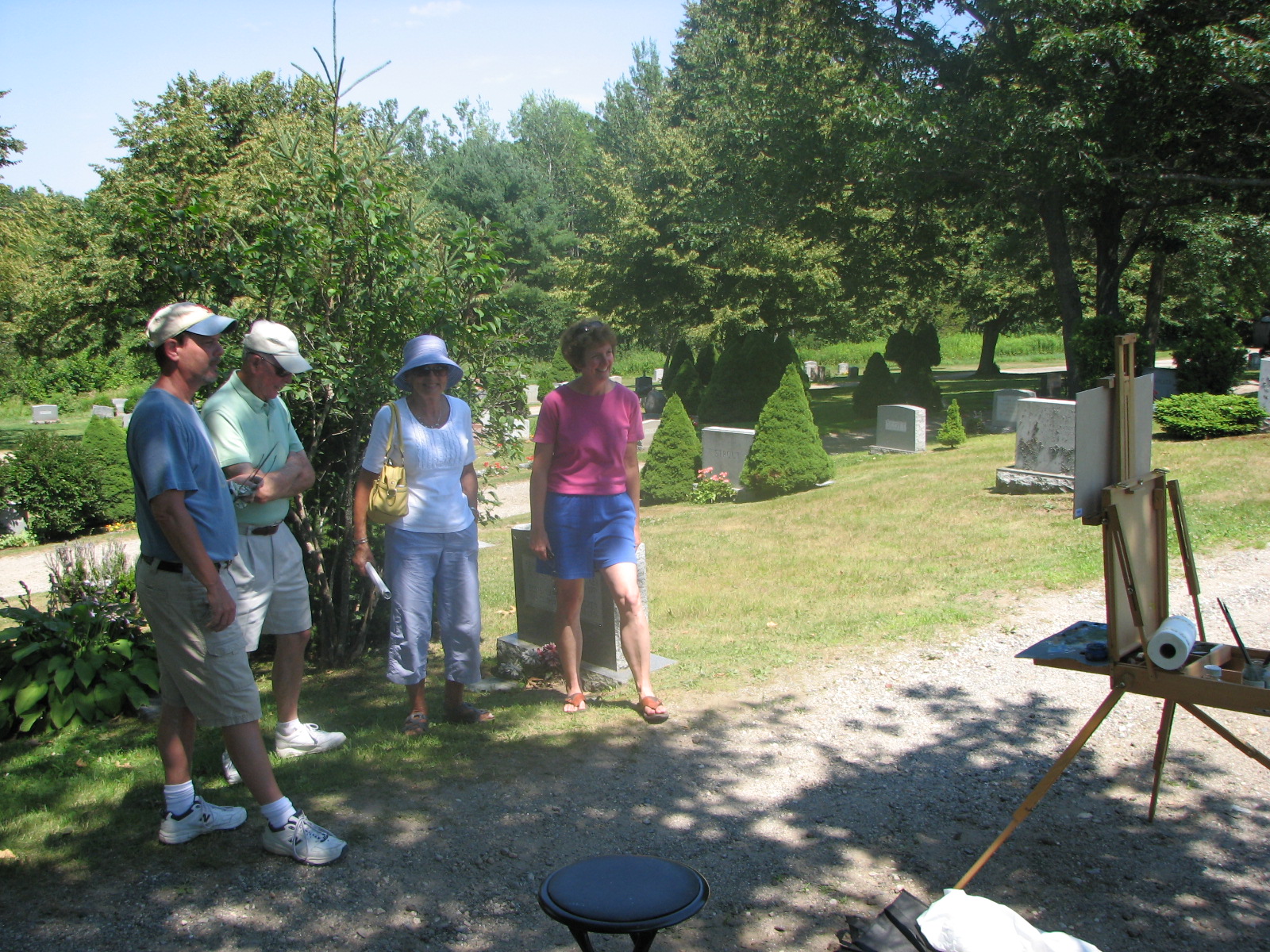
That first year we stacked our paintings on the patio behind the back door.  This year, we had our own tent for viewing.  Here's the folks checking out the art and planning which one they want to bid the most for:


The whole event was squeezed under enough tent to play a football game.


I will freely admit that I had a sinking feeling about my piece when I saw the quality of the paintings that the other painters presented.  I wasn't at all sure that folks would be interested in owning a painting of a bone-yard showing the ass-end of a church.


The good news is that it sold, so somebody must have liked it!  And a few more pennies gets put in the jar to buy up some more land for all to enjoy.

If you're interested in seeing more (unfuzzy) shots of the event, the folks at CELT invite you to this facebook site.  You can see the great art while you sit around your computer, or BBQ, with a beer... playing some lawn darts...


.

Thursday, July 14, 2011

Note To Self...


Hey Kev, don' forget-


Clean your palette after every session.  No one has ever snuck into your studio overnight to do it for you.


Same thing with your brushes.  You need to wash them more frequently than you wash your truck.

Make sure the dog isn't under your table when you gesso panels.


Wait until the gesso splatters dry before you pluck them out of the dogs hair.


Stop pussyfooting around--  Go with your first instincts on your pictures!  When that doesn't work, think it through a little more.


Don't sit outside and plein air bright puffy clouds at high noon on a summer day in the same key as you see them.  It's a fools errand.  The tube of white that's as bright as they has yet to be made.


If you're going to include a structure in your picture, either look up at it or down on it.  Nothing is as boring as a dead on shot.


Remember, if you have to choose between truth or art, choose art.


Call your mom more often.


If you think the painting is done, set it aside for at least a week, then look at it again.  You'll probably change your mind.


Stop confusing "Important" with "Big."  It's how you handle the subject, not the size of the picture that determines that.


Details are good, but it's the shape of the nose that identifies a person, not the nose hairs.


Stop worrying about how the painting will look on your website, and start thinking how it will look on someones wall.


Hurry up and get some patience.


Try variegating solid masses of color a little more;  throw in any colors you want as long as they have the same temperature and value.


White wine goes with white meat, red wine goes with red meat, beer goes with everything.


Admire the artists you like, don't copy them.


Don't try to fix a bad design with color.  If it's a worthwhile subject, start over.


Thank people for commenting on your blog more often.


Remember:  If you aim for good and fall short, you get bad.  Aim for great and fall short-- it might be good.  So aim for perfect-- you might get excellence.


Be sure to retire as soon as you achieve perfection!


.

Saturday, July 9, 2011

What Goes Around Comes Around


There seems to be an ongoing debate these days about the worth of galleries.  To some, galleries are as mysterious, alluring, sexy, and as terrifying as that thirty-five year old divorcee is to a seventeen year old boy.  Others think that galleries are as important as teats on a bull.  I haven't taken any scientific surveys, but it seems like the rabble that are artists are rising up, pitchforks and torches in hand to throw off the mantle that is gallery representation.  In other words, galleries have a bad rep right now.

To tell the truth, it's not like they didn't bring it upon themselves.  For years a gallery was THE place to buy art.  Sure, artists could sell their paintings themselves, and years ago many did from small shops in art-friendly communities.  But those artists died out, and galleries eventually became lords of it all.  It got to be that selling by yourself was the sign of an amateur hack; real artists had gallery representation.  And galleries became the exclusive enclaves where the elite connoisseurs and folks of privilege came to meet and greet over wine and cheese.  Want to get into that club?  Don't call us, we'll call you.  It was a I don't need you, you need me hubris brought on by years of monopolization.  But then came the storm clouds.  After 9-11 the economy slowed down, only to fall off the cliff that is the current recession. 


Sales dried up.  Galleries were dropping out like teeth from a meth-heads mouth.  Many of those that remained open went into full-fledge hide-in-the-bunker survivalist mode; they wouldn't take any new artists because they couldn't sell the ones they had.  (A philosophy that always mystified me:  you won't try to find something that sells in order to hold on to what isn't selling...)  But artists were struggling just as mightily too.  Galleries weren't exclusive clubs anymore, they were lifeboats on the Titanic.  Artists had to look around for other venues, anyplace where they could sell their work.  And that's where the internet came in.


Who needs a brick and mortar store in a fixed location when any one with a computer can view your work from around the globe?  So we all jumped on the internet with our fancy web pages showing our brilliant art and waited for the sales to come pouring in.  Now, some artists do make a fair living from their internet art sales.  But I am going to climb out on a limb here and bet that you don't.  Which is no crime.  The fact of the matter is that all of us artists haven't gone anywhere, we're all just trying a different tact to win the "who sells a painting" game.


But you know what I find rather ironic?  The same internet that was supposed to free us from the bondage of galleries is now being used by artists to attract galleries!  Before, it was, "you must have an internet presence to attract buyers!"  Now, it's "you must have an internet presence to attract galleries!"  But you know what will attract buyers?  A good painting. 


In todays world we have access to every other person on this planet through social media.  Because of that, there has never been a better time than the present for artists to have their work be seen.  Galleries may have a diminished role in making an artist be known, but love 'em or hate 'em, they still are important for sales.  Many galleries are using the same social media that we all use.  And lo-and-behold, alot are even looking for new artists!  So listen, stop bashing the galleries.  Instead of being the gun, now they're a bullet.  We have all kinds of weapons at our disposal to sell paintings.

But no matter how many friends you have on Facebook, or followers on Twitter, the most important thing is making art that people want to buy.


.


Tuesday, July 5, 2011

Purple Haze


Today was one of those summer days that when you take a shower, you can towel off, but never really dry off.  In other words, a tad humid.  Now, some people dislike this element of summer, but I don't mind.  I'll take the humidity along with the heat.  I lived for a couple of years in the desert South West, so I know about heat.  "Oh, but it's dry heat," I can hear you say.  Okay, which one do you want-- a dry 116 degrees, or a humid 88?  But humidity and it's resultant haze can be useful to landscape painters.

In a few weeks I'll be participating for the fourth year in a row in the Cape Elizabeth Land Trust's wet paint and auction event.  It's for a good cause, and it is extremely well organised and run.  It's been my honor to have been chosen to participate all these years.  I am hoping, however, that this year won't have the same weather as last years. 


You see, about twenty or so painters head out to various locations around the quite lovely and bucolic peninsula that is Cape Elizabeth, Maine and do a plein air painting.  I will tell you right now, that I am not really a tried and true plein air type of guy.  I can have good luck with maybe one or two paintings for every four or five attempts.  The others are brutal.  So what I would do is go to my location beforehand, and start my painting, then show up on the day of the event and finish it on site.  Kind of hedge my bet, you know?  It may not be a true plein air in the technical sense, but I'm sure that the organisers of the event don't care how the painting was done, only that it is done well.  So anyway, last year I was assigned to paint along the rugged, rocky coast at a place called Two Lights State Park.  I was excited.  Visions of a Winslow Homer seascape came to mind.  So, a couple of days before, I slipped down to scope out the site.  I took photos and made sketches, then went back to my studio and started in on the painting.  This is going to be great, I thought.  My best yet.  I was getting cocky.


On the appointed day, me and my beautiful partner Ellen went to the park and set up at my site.  The day was as lovely as a summer day can get in Maine.  The sky was a crisp, bright blue with not a cloud in sight.  The sea a tranquil deep blue with waves that gently nudged the gray rocks of the coastline.  A breeze was blowing from the west.  Oh, my God-- what a freakin' nightmare!  Because I had to wait until the park was open to get in and start painting, the sun was well above the horizon.  And it was dullness as far as the eye could see.  Deep, black shadows hid under the slate gray stones.  The sky was an interminably flat light blue.  The ocean was just as horrifically a boring blue.  And the wind kept trying to knock my easel over. 


I swear it would not have been a problem if there had been some humidity in the air to soften the shadows, push the ocean back into a purple haze, and allow the sky to form some interesting clouds.  Maybe Winslow could've fudged it a little to make an interesting painting.  I could not.


I needed to come up with something else, because my pre-planned painting was a bomb.  I quickly hauled out a blank panel and started in on a new scene, but by now, my brain was becoming a panic stricken piece of mush, and I couldn't seem to pull anything out.  If the year before I had done a good plein air painting for the event, then I was now in the middle of my five bad ones.  Oh, and I had until two o'clock to finish it and get it to the auction site.  What time was it now?  Noon.  Why, oh, why did I ever sign up for this...


So what did I do?  Luckily, I had brought a seascape I had already finished of the same general area with me, (after all, ocean and rocks-- who can say where's where?) and I slapped a few dabs of fresh paint on it and presented it for the auction.  Cheating?  Maybe.  But what would you do? 

So, let's hope that this year won't find me under the same stress.  Is a little stifling heat and unbearable humidity too much to ask for?


.

Sunday, June 26, 2011

Quiet, Please!


I don't know about you, but I don't really need absolute isolation and quiet when I paint.  I usually have the stereo on, and my dog Champ putters about the studio while I stand and paint.  That doesn't bother me.  Heck, I've painted in front of crowds of friends and strangers.  No problem.  And it wouldn't even bother me if a marching band blasted away while they marched by my studio.  Let 'em.  But the one place I need quiet from is the space between my ears.

I don't think of myself as a "temperamental artist" sort of guy.  I like to think that my job is being a painter, not one of God's anointed ones to bring truth, enlightenment and beauty to this world.  I do take my job seriously, but all-in-all, I just try to make good paintings.  So it bothers me when I have difficulty concentrating on the task at hand because I'm preoccupied by something else.  I'm not talking about anything major, but I'll give you an example.  We've had a less than spectacular Spring and Summer here in Maine, but that hasn't kept the grass from growing.  So, when I'm working on a painting on a lovely summer day, I'm thinking about mowing the lawn, because the forecast is for rain, and it needs to be done.  But when it's been rainy and miserable, (which has been most of the time) I'm preoccupied with what I'm going to paint when it turns nice.  But then, I'll have to mow the lawn...  Now, I should say here that mowing the lawn entails a six-hour ride on the lawn tractor.  But, damn, those lawn stripes look so good.

There are other things going on in my life right now (nothing horrible, thank goodness) that have been occupying my mind.  But I can't make a good painting when my brain is chattering away with itself on things that have nothing to do with the task at hand.  Painting needs to have my undivided attention-- just like those temperamental artist types.  So I need for my brain to shut up and get back to work!

I used to inwardly snigger when I would read an account of some famous artist who needed to be insulated from life's little distractions so he could create yet another masterpiece.  But now, I kinda get it.  Would my painting be so much better if I could just lock myself in my studio and never worry about what goes on in the world around me?  I don't know.  But I do know this:

Michelangelo never had to climb down from the Sistene Chapel ceiling and mow the damn yard!


.

Friday, June 10, 2011

Re-Poo-Say-Wha?


Earlier this year I had a chat with a local art critic who was kind of reviewing my work.  (I blogged about it here)  He looked at my work and said, "I see you like repoussoir."  I replied, "Well, not since High School..."

He stared at me blankly.

Thomas Fogarty,  Norman Rockwells composition teacher when he was attending the Art Students League advised, "Put something in the foreground of your pictures to make the viewer step over it and into the frame."  That is the definition of repoussoir.   (Don't ask me how to pronounce it!)

Artists are always trying to add depth to their two dimensional paintings.  Maybe using lineal perspective; you know, a road that narrows away to the vanishing point on the horizon, or atmospheric perspective; where a series of hills grow bluer as they recede into the distance.  Or maybe a combination of both.  Another device is to have something in the foreground that says, "I am close to you."  Then an object in the middle distance, and lastly, something farther off in the distance.  It's a typical tactic that can add depth to a composition, and something that I usually try to incorporate in my own paintings.  You see it all the time in landscape paintings and illustrations by the great old illustrators.

How many landscape paintings have you seen where the foreground is in shadow, and the rest of the scene is bathed in sunlight?  That's an example of repoussoir, like this painting by George Innes: 


Or how about this painting by Rockwell, Saying Grace--


You have to look past the figure on the left, and the table in front of you to see the little old lady and her grandson saying grace.  Remove him and that beautifully painted cup of coffee and the scene just flattens out with everyone the same distance away.  It would look like The Last Supper.  At the top of the page is a Tom Lovell painting where he uses the same motif. 

Speaking of the great Tom Lovell, here's another example


Same thing as with Norman-- The gentleman on the left has nothing to do with the main group in the middle.  He's only there to give a sense of space.

I did the same thing with the stool in the foreground of Diner:


I've passed up painting many a lobster boat scene, because the boat was just bobbing around in the water with nothing to identify it as being a certain distance away.  It would look like it was just floating in mid-air with nothing to ground it, as it were.  I'm way too anal to be satisfied with just portraying pretty objects with nice colors.  I have to have them occupy some kind of space.  Otherwise, to me it's not a whole scene, and I like my scenes whole.


Can a repoussoir be done wrong?  Can a match burn down a forest?  There's a fine line between invitation and barrier when it comes to foreground handling.  Like any good thing in life, if its done well, it's not noticed.  You don't want your repoussier to call attention to itself.  Having a ram-rod straight horizontal object occupy the entire bottom of you picture is a barrier.  But a few blades of grass jutting up into the bottom of a painting won't cut it, either.  It's a judgement call.

So the next time you're designing a picture, instead of saying, "what?"  Say, "Repoussoir" instead!


.

Tuesday, June 7, 2011

Occupational Hazards


After waiting all winter long for a spring that failed to arrive, summer came to Maine last week.  I love June.  The days are at their longest, the spring flowers are blooming, and whatever heat there is hasn't worn out it's welcome like it would in August.  A perfect month.  So to celebrate, I loaded up my paint gear and headed out of the confines of my studio to paint me a picture out doors.  My first attempt was at Wolfe's Neck Farm in Freeport, Maine for their charity auction.  I wasn't thrilled with it, so I did another painting for them on the next day.  Here are some cows for them--


A spot of glare on that one, sorry...  But it put me in the mood to keep on going.  So, yesterday I took my gear for a ride, and stumbled upon a blueberry field.


I thought this scene had potential, so I set up in a ditch along the dusty dirt road, and started in.  I could have just as easily turned around and painted this--


But I felt the other view had more interest.  I like rock walls.  I look at them in awe as a memorial to the farmers who cleared the primeval forest over two hundred years ago, then found out that Maine soil is infested with rocks.  So having no other use for them, they partitioned off their fields with these rocks.  Undoubtedly back breaking, labor intensive efforts that now are lost to the forest that grew back when the farmers gave up.  So I think it's cool when I get a chance to actually see them out in the open.


Here's my initial underpainting of the scene--


What you don't see are the spiders.  Apparently, spiders dig plein air painters.  Those guys were crawling all over me all day.  There I'd be, staring out at the field, when I'd see a spider hanging down from the bill of my cap, dangling in front of my eyes.  But I didn't mind so much.  The wind was gentle, and blowing just hard enough to keep the black flies and mosquitoes away.  So if a spider wanted to visit, so what?  The sun was shining, and the only sound was the wind in the trees and the crowing of a distant rooster.  I even had a more welcome visitor wander by--


So really, why complain?  After I packed up to leave, I decided to go into the field behind me.  In the middle of the blueberry field is a small cemetery, and I wanted to check it out.


I was so intent on seeing the graves I walked right into the bee-hives that the farmers used to pollinate the fields--


You can't see them, but trust me, they were swarming.  Now, I'm not allergic to bees, nor am I especially afraid of them.  They are just bugs, and like most creatures, they just want to be left alone.  However, to bees, it seems like walking in their midst isn't leaving them alone.  It reminded me of when I was a teenager, and my dad had me pulling stumps in the back yard.  The stumps were old and rotten, and they came up easy.  Just a couple swings from my pick-axe did the trick.  I wasn't prepared for what happened next.  I planted my pick into a stump, and instantly felt stinging pain strike me all over.  The air was filled with the sound of violent buzzing.  I had hit a nest of yellow-jackets!  I dropped my pick and ran as fast as I could to the house, half blind from insects crawling on my face.  I had about two-dozen stings on me.  And it all took place in about fifteen seconds.


Let's just leave it that I didn't go to the cemetery, shall we?  Okay, I'll admit it--- I ran away like a school girl...


I'm going to do some more work on my painting in the studio.  Finish up the rock wall, add some foliage to the foreground, tweak some colors here and there-- you know, stuff that I can do from memory.  And the best part? 


No spiders... no bees...


.

Saturday, June 4, 2011

Down On The Farm


Long before L.L.Bean set up shop, and the town council lost their minds and let anyone with the last name of "Outlet" take over the town, Freeport was a quiet country town on Maine's coast.  Still holding on to the remnant of what once was, Wolfe's Neck Farm operates as a working farm clinging to the thin soil along the rocky coastline.  It is a lovely site.  From the century old farm house, the ground is acres of rolling verdant meadows that slope gently down to the shoreline. 

Back in the day, coastal property wasn't worth much.  It's soil is thin with plow-breaking rock a mere inches below the topsoil, so farming wasn't very good.  It was generally the property of sea going types who had no need to grow anything.  Land on the coast could be had for half of what the same amount of acres cost farther inland. 

Then someone noticed the view. 


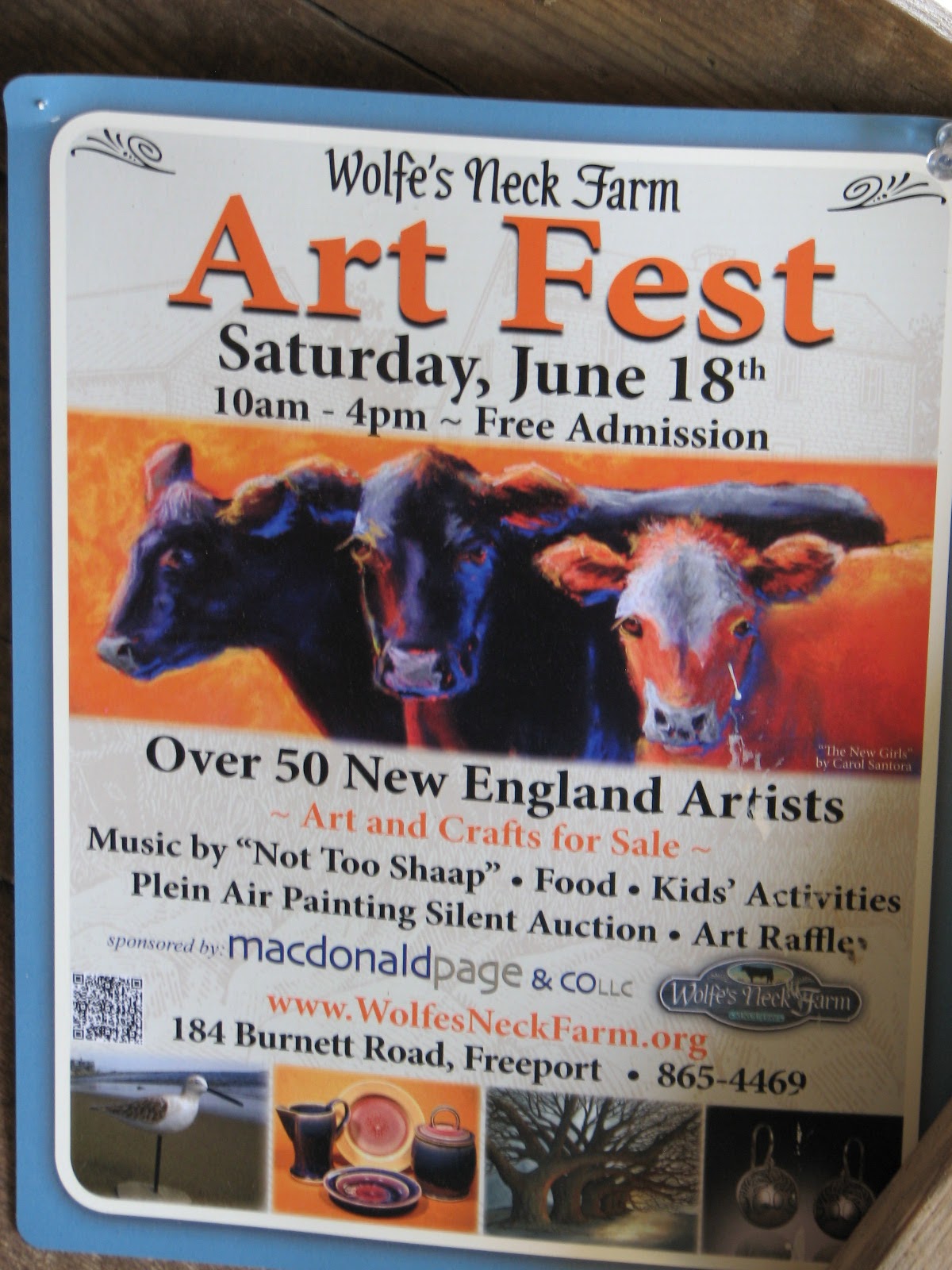
The same Atlantic ocean that was thought of as nothing more than a salt water desert became an object to admire and desire.  So the land was bought up, mansions were built, access to the water cut off by the new land owners, and the farms disappeared.  That's where Wolfe's Neck Farm comes in.  The town of Freeport actually had the foresight to set aside the land that this old farm occupied so that future generations could enjoy a little taste of what earlier generations took for granted.  But nothing is free, and Wolfe's Neck Farm needs cash to operate, just like any business.

The folks on the farm are using us artists as fund raisers.  This week, about a dozen or so of us are painting en plein aire around the farm, and these paintings will be auctioned off on June 18th.  I went out there to work on mine today.  Here is my start:


And here is what I'm actually looking at:


When I showed up, there were several cows standing around this scene, doing typical cow things.  As I blocked in the picture, they got bored and left.  That left me with no cows.  I have to put the cows back in, or nobody would know I was on a farm.  You may wonder as to why my painting is in black and white?  That's my standard method.  I'll block in a scene, then go back and apply color.  I knew that I would not finish a complete painting today.  I'm going back at the same time tomorrow to work on it some more.  Then I may tweak it a bit in the studio before I submit it for auction on Friday.  I'm not overly concerned that it may not be a plein aire as is commonly understood today, all I care about is that it's a good painting, and can fetch a good price.  Years from now, nobody will give a rats ass that I did this over the course of a few days.


I'll post a picture on how this comes out-- good or bad.  (Although, I'm hoping for the good.)  After all--how can I let a face like this down?


.

Monday, May 30, 2011

Teacher, Teacher!


Looking at my viewer counter, I noticed I have reached the ten thousand mark for the number of hits my blog has received.  So, not counting the number of times I have checked out my blog, that means twenty seven other people have looked at my blog too!  How exciting... 

For those who wake each morning in eager anticipation of seeing a fresh and new Maine-ly Painting post, I apologize for slacking recently.  But, hey-- I've been busy!  I just got back from the Philadelpia, Pa. area where I made a quick trip to deliver some paintings to a new gallery that will represent me.  That was cool.  I've also been giving some instruction to a nice guy who wants to learn how to paint-- NOW!  I feel bad for him, because when he asks, "How do I paint that tree?"  I say, "Keep putting paint down 'til it looks like the tree."  Drives him nuts.  He still thinks there's a direction sheet for painting.  Like putting a swing set together;  Screw A goes into nut G after tightening bolt Q.  That kind of thing.  He doesn't quite get that no matter how good you are, painting is still trial and error.  Granted, if you're really good there's less error, but everyone scrapes off a mistake now and then.

Learning any new skill always reminds me of learning to write.  We spend years in school learning how to form letters, then how to spell words.  Finally, we can write our thoughts without ever thinking about the mechanics of forming letters.  All we care about is what we're trying to say.  My poor student (let's call him Steve, even if his name is Jim...)  is chomping at the bit to write War And Peace, but he hasn't learned how to make letters yet.  So I can understand his frustration.  It also dosn't help him when I say things like, "Make the brush think it's the ocean, " or "Move that brush like it's the cloud."  Quite often when he asks something like, "How do I paint that rock?"  I'll say, "The same way you paint a tree."  Actually, I'm trying to get him to think about values, and highlights and shadows.  He just thinks I'm insane.  Wish he was wrong...


I've given lots of training and instruction throughout my life with the various jobs I've held.  The hardest part is that I'm a bit of a control freak.  I hate to see people suffer when I know how it should be done.  But I had to fight the overwhelming urge to do it myself, and just let my poor trainee do it for themselves.  Trust me, it was harder for me than it was for them.  Learning from mistakes is an effective way to learn.  Steve is always asking for me to paint a passage so he can watch how I do it.  He hasn't caught on that I will do the easiest part, then hand him the brush to finish the harder part. 


I try to not think about the old adage about those that can-- do.  Those that can't?


They watch others suffer and call themselves teachers!


.

Wednesday, May 18, 2011

CSI: Photos Of Paintings


Sorry about whining about the weather in my last blog.  Thankfully, here in Maine the weather has turned.  It's gone from clouds, fog and drizzle to foggy, drizzly and cloudy.  It has also played havoc in my trying to get some decent photos of my recent paintings.  I usually take my pictures in bright sunshine, but the aforementioned weather has precluded that.  I tried to take pictures anyway, but you know it's dim out when the camera prompts you to use a flash even when outdoors at noon!  So I took them here in the studio instead.  The painting above is called Spring Flood, and it shows my back field flooded out by the Eastern River that runs along between it and the trees being lit up by the last fews rays of sunlight.

I recently mentioned in a blog post about my troubles with getting decent photos of my paintings.  I think it's a crime when a good painting in person looks so bad in a photograph.  It got me to wondering why some paintings (usually others) photograph well, and some (usually mine) don't.  I likened it to that sad occurrence that happens to nice people who just take a bad photo.  Like Abraham Lincoln.


                                                               Or Phil Spector.


This guy produced some of the greatest hits of the 60's?  Phil, it looks like you lost that lovin' feeling!  But I digress...


I got to thinking about other possibilities as to why photos of paintings don't turn out very well, and I've come up with a  theory.  Keeping in mind that sometimes it really is an accurate photo of a crappy painting, I think it is all about the range of values a painting has.

You see, a camera is always trying to play the middle, specially when there's a great deal of contrast involved.  Look at this photo of Cundy's Harbor during a gorgeous summer sunrise:


But also note how dark-- almost black-- the fore and middle-ground is.  In reality, the sky was much brighter and more colorful, the trees across the way were a lovely green, and the wharf which was full of yellow, green and blue lobster traps was perfectly visible.  But the photo only shows the sky with color.  That's because the camera lowered the values of everything so that the sky wouldn't be overexposed, leaving everything else super dark.  It can't brighten one section and darken another-- it's all or nothing.  If the dominant subject was the shadowed wharf, the camera would have lightened the values to show those colors, but at the expense of the sky.   Another example is of my local church on yet another glorious summer day.  (Definitely not this year!):


Beautiful sky, but look how dark the trees and shadows are.  When I focused on the church without the sky, it showed the truer values of the scene.


So what does this have to do with photographing paintings?  Well, a camera doesn't know or care what it's taking a picture of.  It treats everything in the same manner, including paintings.  So, if your (my) painting has alot of contrast, the camera will do it's thing and mess with the values.  Which means if your painting has a value range that's mostly high-keyed, or mostly low-keyed, without much contrast you're probably in luck.  If your (my) painting runs the gamut between high and low values, with tons of contrast-- you're screwed.  A camera absolutely hates that lovely deep purple shadow next to a bright golden yellow high-light that you're so proud of.  It'll either over-expose the high-light into a white blob to show the purple, or darken it, turning the shadow into a black hole.  Either way you (I) lose.

I asked in my previous post if I should paint for the human eye or the camera eye.  After all, if you the visitor is pleased with my painting, and you think I did a realistic job, then I did OK, didn't I?  But what is the more likely way you will see my painting?  Online, that's how.  And what is that image online?  A painting?  No, it's not-- it's a photograph of a painting.  So I guess I better keep that in mind when I'm painting, since I don't want my pictures to look criminally bad.  After all, I don't need this guy to come after me--


.

Monday, May 16, 2011

Gotta Love It!


I told myself that I would not use this post to discuss the weather here in Maine.  I mean, nobody wants to read about how this "spring" has been unusually cloudy, rainy and cold.  That since April first we've been rained on forty out of forty-six days.  How shallow is it of me to complain about ceaseless drizzle when there's flooding in the midwest, and massive destruction from tornados in the south?  So I won't mention that today it's raining for the third straight day.  Enough said.  Or that the temperature has yet to crest seventy degrees yet this season.  OK, I'll stop whining.

But according to the Weather Channel's ten day forecast, we're looking at ten straight days of rain with temps around fifty.

I mean it, I'm done now.  I've got it all out of my system.

Wait!  Look out my studio window...  What's that I see?

Drizzle and fog.

What I wanted to mention is that last week a very nice person and wonderful sketch artist from the UK named Katherine Tyrell asked me to contribute to her blog series called Places To Paint with a few words about Maine.  So, gentle reader, if you want to know what I said, please go to her blog Places To Paint and I'll give you a tour of what I actually like about painting here.  Here's a hint:

I don't mention the weather.