Sunday, June 26, 2011

Quiet, Please!


I don't know about you, but I don't really need absolute isolation and quiet when I paint.  I usually have the stereo on, and my dog Champ putters about the studio while I stand and paint.  That doesn't bother me.  Heck, I've painted in front of crowds of friends and strangers.  No problem.  And it wouldn't even bother me if a marching band blasted away while they marched by my studio.  Let 'em.  But the one place I need quiet from is the space between my ears.

I don't think of myself as a "temperamental artist" sort of guy.  I like to think that my job is being a painter, not one of God's anointed ones to bring truth, enlightenment and beauty to this world.  I do take my job seriously, but all-in-all, I just try to make good paintings.  So it bothers me when I have difficulty concentrating on the task at hand because I'm preoccupied by something else.  I'm not talking about anything major, but I'll give you an example.  We've had a less than spectacular Spring and Summer here in Maine, but that hasn't kept the grass from growing.  So, when I'm working on a painting on a lovely summer day, I'm thinking about mowing the lawn, because the forecast is for rain, and it needs to be done.  But when it's been rainy and miserable, (which has been most of the time) I'm preoccupied with what I'm going to paint when it turns nice.  But then, I'll have to mow the lawn...  Now, I should say here that mowing the lawn entails a six-hour ride on the lawn tractor.  But, damn, those lawn stripes look so good.

There are other things going on in my life right now (nothing horrible, thank goodness) that have been occupying my mind.  But I can't make a good painting when my brain is chattering away with itself on things that have nothing to do with the task at hand.  Painting needs to have my undivided attention-- just like those temperamental artist types.  So I need for my brain to shut up and get back to work!

I used to inwardly snigger when I would read an account of some famous artist who needed to be insulated from life's little distractions so he could create yet another masterpiece.  But now, I kinda get it.  Would my painting be so much better if I could just lock myself in my studio and never worry about what goes on in the world around me?  I don't know.  But I do know this:

Michelangelo never had to climb down from the Sistene Chapel ceiling and mow the damn yard!


.

Friday, June 10, 2011

Re-Poo-Say-Wha?


Earlier this year I had a chat with a local art critic who was kind of reviewing my work.  (I blogged about it here)  He looked at my work and said, "I see you like repoussoir."  I replied, "Well, not since High School..."

He stared at me blankly.

Thomas Fogarty,  Norman Rockwells composition teacher when he was attending the Art Students League advised, "Put something in the foreground of your pictures to make the viewer step over it and into the frame."  That is the definition of repoussoir.   (Don't ask me how to pronounce it!)

Artists are always trying to add depth to their two dimensional paintings.  Maybe using lineal perspective; you know, a road that narrows away to the vanishing point on the horizon, or atmospheric perspective; where a series of hills grow bluer as they recede into the distance.  Or maybe a combination of both.  Another device is to have something in the foreground that says, "I am close to you."  Then an object in the middle distance, and lastly, something farther off in the distance.  It's a typical tactic that can add depth to a composition, and something that I usually try to incorporate in my own paintings.  You see it all the time in landscape paintings and illustrations by the great old illustrators.

How many landscape paintings have you seen where the foreground is in shadow, and the rest of the scene is bathed in sunlight?  That's an example of repoussoir, like this painting by George Innes: 


Or how about this painting by Rockwell, Saying Grace--


You have to look past the figure on the left, and the table in front of you to see the little old lady and her grandson saying grace.  Remove him and that beautifully painted cup of coffee and the scene just flattens out with everyone the same distance away.  It would look like The Last Supper.  At the top of the page is a Tom Lovell painting where he uses the same motif. 

Speaking of the great Tom Lovell, here's another example


Same thing as with Norman-- The gentleman on the left has nothing to do with the main group in the middle.  He's only there to give a sense of space.

I did the same thing with the stool in the foreground of Diner:


I've passed up painting many a lobster boat scene, because the boat was just bobbing around in the water with nothing to identify it as being a certain distance away.  It would look like it was just floating in mid-air with nothing to ground it, as it were.  I'm way too anal to be satisfied with just portraying pretty objects with nice colors.  I have to have them occupy some kind of space.  Otherwise, to me it's not a whole scene, and I like my scenes whole.


Can a repoussoir be done wrong?  Can a match burn down a forest?  There's a fine line between invitation and barrier when it comes to foreground handling.  Like any good thing in life, if its done well, it's not noticed.  You don't want your repoussier to call attention to itself.  Having a ram-rod straight horizontal object occupy the entire bottom of you picture is a barrier.  But a few blades of grass jutting up into the bottom of a painting won't cut it, either.  It's a judgement call.

So the next time you're designing a picture, instead of saying, "what?"  Say, "Repoussoir" instead!


.

Tuesday, June 7, 2011

Occupational Hazards


After waiting all winter long for a spring that failed to arrive, summer came to Maine last week.  I love June.  The days are at their longest, the spring flowers are blooming, and whatever heat there is hasn't worn out it's welcome like it would in August.  A perfect month.  So to celebrate, I loaded up my paint gear and headed out of the confines of my studio to paint me a picture out doors.  My first attempt was at Wolfe's Neck Farm in Freeport, Maine for their charity auction.  I wasn't thrilled with it, so I did another painting for them on the next day.  Here are some cows for them--


A spot of glare on that one, sorry...  But it put me in the mood to keep on going.  So, yesterday I took my gear for a ride, and stumbled upon a blueberry field.


I thought this scene had potential, so I set up in a ditch along the dusty dirt road, and started in.  I could have just as easily turned around and painted this--


But I felt the other view had more interest.  I like rock walls.  I look at them in awe as a memorial to the farmers who cleared the primeval forest over two hundred years ago, then found out that Maine soil is infested with rocks.  So having no other use for them, they partitioned off their fields with these rocks.  Undoubtedly back breaking, labor intensive efforts that now are lost to the forest that grew back when the farmers gave up.  So I think it's cool when I get a chance to actually see them out in the open.


Here's my initial underpainting of the scene--


What you don't see are the spiders.  Apparently, spiders dig plein air painters.  Those guys were crawling all over me all day.  There I'd be, staring out at the field, when I'd see a spider hanging down from the bill of my cap, dangling in front of my eyes.  But I didn't mind so much.  The wind was gentle, and blowing just hard enough to keep the black flies and mosquitoes away.  So if a spider wanted to visit, so what?  The sun was shining, and the only sound was the wind in the trees and the crowing of a distant rooster.  I even had a more welcome visitor wander by--


So really, why complain?  After I packed up to leave, I decided to go into the field behind me.  In the middle of the blueberry field is a small cemetery, and I wanted to check it out.


I was so intent on seeing the graves I walked right into the bee-hives that the farmers used to pollinate the fields--


You can't see them, but trust me, they were swarming.  Now, I'm not allergic to bees, nor am I especially afraid of them.  They are just bugs, and like most creatures, they just want to be left alone.  However, to bees, it seems like walking in their midst isn't leaving them alone.  It reminded me of when I was a teenager, and my dad had me pulling stumps in the back yard.  The stumps were old and rotten, and they came up easy.  Just a couple swings from my pick-axe did the trick.  I wasn't prepared for what happened next.  I planted my pick into a stump, and instantly felt stinging pain strike me all over.  The air was filled with the sound of violent buzzing.  I had hit a nest of yellow-jackets!  I dropped my pick and ran as fast as I could to the house, half blind from insects crawling on my face.  I had about two-dozen stings on me.  And it all took place in about fifteen seconds.


Let's just leave it that I didn't go to the cemetery, shall we?  Okay, I'll admit it--- I ran away like a school girl...


I'm going to do some more work on my painting in the studio.  Finish up the rock wall, add some foliage to the foreground, tweak some colors here and there-- you know, stuff that I can do from memory.  And the best part? 


No spiders... no bees...


.

Saturday, June 4, 2011

Down On The Farm


Long before L.L.Bean set up shop, and the town council lost their minds and let anyone with the last name of "Outlet" take over the town, Freeport was a quiet country town on Maine's coast.  Still holding on to the remnant of what once was, Wolfe's Neck Farm operates as a working farm clinging to the thin soil along the rocky coastline.  It is a lovely site.  From the century old farm house, the ground is acres of rolling verdant meadows that slope gently down to the shoreline. 

Back in the day, coastal property wasn't worth much.  It's soil is thin with plow-breaking rock a mere inches below the topsoil, so farming wasn't very good.  It was generally the property of sea going types who had no need to grow anything.  Land on the coast could be had for half of what the same amount of acres cost farther inland. 

Then someone noticed the view. 


The same Atlantic ocean that was thought of as nothing more than a salt water desert became an object to admire and desire.  So the land was bought up, mansions were built, access to the water cut off by the new land owners, and the farms disappeared.  That's where Wolfe's Neck Farm comes in.  The town of Freeport actually had the foresight to set aside the land that this old farm occupied so that future generations could enjoy a little taste of what earlier generations took for granted.  But nothing is free, and Wolfe's Neck Farm needs cash to operate, just like any business.

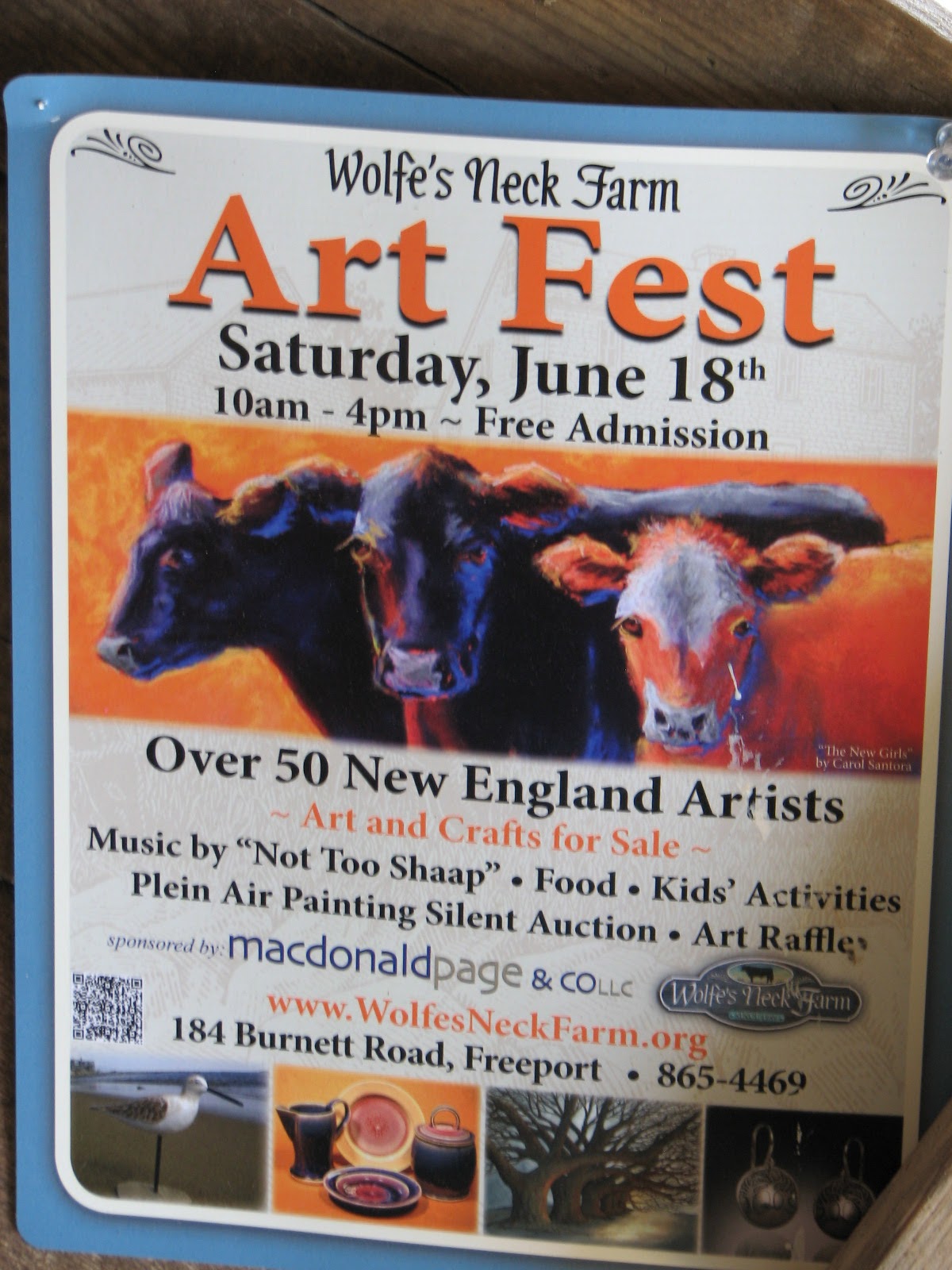
The folks on the farm are using us artists as fund raisers.  This week, about a dozen or so of us are painting en plein aire around the farm, and these paintings will be auctioned off on June 18th.  I went out there to work on mine today.  Here is my start:


And here is what I'm actually looking at:


When I showed up, there were several cows standing around this scene, doing typical cow things.  As I blocked in the picture, they got bored and left.  That left me with no cows.  I have to put the cows back in, or nobody would know I was on a farm.  You may wonder as to why my painting is in black and white?  That's my standard method.  I'll block in a scene, then go back and apply color.  I knew that I would not finish a complete painting today.  I'm going back at the same time tomorrow to work on it some more.  Then I may tweak it a bit in the studio before I submit it for auction on Friday.  I'm not overly concerned that it may not be a plein aire as is commonly understood today, all I care about is that it's a good painting, and can fetch a good price.  Years from now, nobody will give a rats ass that I did this over the course of a few days.


I'll post a picture on how this comes out-- good or bad.  (Although, I'm hoping for the good.)  After all--how can I let a face like this down?


.

Monday, May 30, 2011

Teacher, Teacher!


Looking at my viewer counter, I noticed I have reached the ten thousand mark for the number of hits my blog has received.  So, not counting the number of times I have checked out my blog, that means twenty seven other people have looked at my blog too!  How exciting... 

For those who wake each morning in eager anticipation of seeing a fresh and new Maine-ly Painting post, I apologize for slacking recently.  But, hey-- I've been busy!  I just got back from the Philadelpia, Pa. area where I made a quick trip to deliver some paintings to a new gallery that will represent me.  That was cool.  I've also been giving some instruction to a nice guy who wants to learn how to paint-- NOW!  I feel bad for him, because when he asks, "How do I paint that tree?"  I say, "Keep putting paint down 'til it looks like the tree."  Drives him nuts.  He still thinks there's a direction sheet for painting.  Like putting a swing set together;  Screw A goes into nut G after tightening bolt Q.  That kind of thing.  He doesn't quite get that no matter how good you are, painting is still trial and error.  Granted, if you're really good there's less error, but everyone scrapes off a mistake now and then.

Learning any new skill always reminds me of learning to write.  We spend years in school learning how to form letters, then how to spell words.  Finally, we can write our thoughts without ever thinking about the mechanics of forming letters.  All we care about is what we're trying to say.  My poor student (let's call him Steve, even if his name is Jim...)  is chomping at the bit to write War And Peace, but he hasn't learned how to make letters yet.  So I can understand his frustration.  It also dosn't help him when I say things like, "Make the brush think it's the ocean, " or "Move that brush like it's the cloud."  Quite often when he asks something like, "How do I paint that rock?"  I'll say, "The same way you paint a tree."  Actually, I'm trying to get him to think about values, and highlights and shadows.  He just thinks I'm insane.  Wish he was wrong...


I've given lots of training and instruction throughout my life with the various jobs I've held.  The hardest part is that I'm a bit of a control freak.  I hate to see people suffer when I know how it should be done.  But I had to fight the overwhelming urge to do it myself, and just let my poor trainee do it for themselves.  Trust me, it was harder for me than it was for them.  Learning from mistakes is an effective way to learn.  Steve is always asking for me to paint a passage so he can watch how I do it.  He hasn't caught on that I will do the easiest part, then hand him the brush to finish the harder part. 


I try to not think about the old adage about those that can-- do.  Those that can't?


They watch others suffer and call themselves teachers!


.

Wednesday, May 18, 2011

CSI: Photos Of Paintings


Sorry about whining about the weather in my last blog.  Thankfully, here in Maine the weather has turned.  It's gone from clouds, fog and drizzle to foggy, drizzly and cloudy.  It has also played havoc in my trying to get some decent photos of my recent paintings.  I usually take my pictures in bright sunshine, but the aforementioned weather has precluded that.  I tried to take pictures anyway, but you know it's dim out when the camera prompts you to use a flash even when outdoors at noon!  So I took them here in the studio instead.  The painting above is called Spring Flood, and it shows my back field flooded out by the Eastern River that runs along between it and the trees being lit up by the last fews rays of sunlight.

I recently mentioned in a blog post about my troubles with getting decent photos of my paintings.  I think it's a crime when a good painting in person looks so bad in a photograph.  It got me to wondering why some paintings (usually others) photograph well, and some (usually mine) don't.  I likened it to that sad occurrence that happens to nice people who just take a bad photo.  Like Abraham Lincoln.


                                                               Or Phil Spector.


This guy produced some of the greatest hits of the 60's?  Phil, it looks like you lost that lovin' feeling!  But I digress...


I got to thinking about other possibilities as to why photos of paintings don't turn out very well, and I've come up with a  theory.  Keeping in mind that sometimes it really is an accurate photo of a crappy painting, I think it is all about the range of values a painting has.

You see, a camera is always trying to play the middle, specially when there's a great deal of contrast involved.  Look at this photo of Cundy's Harbor during a gorgeous summer sunrise:


But also note how dark-- almost black-- the fore and middle-ground is.  In reality, the sky was much brighter and more colorful, the trees across the way were a lovely green, and the wharf which was full of yellow, green and blue lobster traps was perfectly visible.  But the photo only shows the sky with color.  That's because the camera lowered the values of everything so that the sky wouldn't be overexposed, leaving everything else super dark.  It can't brighten one section and darken another-- it's all or nothing.  If the dominant subject was the shadowed wharf, the camera would have lightened the values to show those colors, but at the expense of the sky.   Another example is of my local church on yet another glorious summer day.  (Definitely not this year!):


Beautiful sky, but look how dark the trees and shadows are.  When I focused on the church without the sky, it showed the truer values of the scene.


So what does this have to do with photographing paintings?  Well, a camera doesn't know or care what it's taking a picture of.  It treats everything in the same manner, including paintings.  So, if your (my) painting has alot of contrast, the camera will do it's thing and mess with the values.  Which means if your painting has a value range that's mostly high-keyed, or mostly low-keyed, without much contrast you're probably in luck.  If your (my) painting runs the gamut between high and low values, with tons of contrast-- you're screwed.  A camera absolutely hates that lovely deep purple shadow next to a bright golden yellow high-light that you're so proud of.  It'll either over-expose the high-light into a white blob to show the purple, or darken it, turning the shadow into a black hole.  Either way you (I) lose.

I asked in my previous post if I should paint for the human eye or the camera eye.  After all, if you the visitor is pleased with my painting, and you think I did a realistic job, then I did OK, didn't I?  But what is the more likely way you will see my painting?  Online, that's how.  And what is that image online?  A painting?  No, it's not-- it's a photograph of a painting.  So I guess I better keep that in mind when I'm painting, since I don't want my pictures to look criminally bad.  After all, I don't need this guy to come after me--


.

Monday, May 16, 2011

Gotta Love It!


I told myself that I would not use this post to discuss the weather here in Maine.  I mean, nobody wants to read about how this "spring" has been unusually cloudy, rainy and cold.  That since April first we've been rained on forty out of forty-six days.  How shallow is it of me to complain about ceaseless drizzle when there's flooding in the midwest, and massive destruction from tornados in the south?  So I won't mention that today it's raining for the third straight day.  Enough said.  Or that the temperature has yet to crest seventy degrees yet this season.  OK, I'll stop whining.

But according to the Weather Channel's ten day forecast, we're looking at ten straight days of rain with temps around fifty.

I mean it, I'm done now.  I've got it all out of my system.

Wait!  Look out my studio window...  What's that I see?

Drizzle and fog.

What I wanted to mention is that last week a very nice person and wonderful sketch artist from the UK named Katherine Tyrell asked me to contribute to her blog series called Places To Paint with a few words about Maine.  So, gentle reader, if you want to know what I said, please go to her blog Places To Paint and I'll give you a tour of what I actually like about painting here.  Here's a hint:

I don't mention the weather.


Monday, May 9, 2011

Half-Way There And Other Thoughts


I can usually gage when I'm about half-way through a painting-- not by determining how much I may have left to go before I finish, but when I feel I have screwed the thing up beyond repair.  That's the stage I'm at right now with my current project.  It's kinda alright if you stand far enough away.  And close one eye.  Then squint.  While looking through your cupped hand.  While you're upside down and looking at it from between your legs.  With the lights off.  But stand up, turn around, open your eyes and turn on the lights and it's a different story.  I don't think I'm the only one who's felt that way during a painting.  I read once that Norman Rockwell called it the, "My gosh, it's horrible!" stage.  And as I always say, if it's good enough for Norman...


After my recent blog By Definition where I kind of rant about what I think art is not, I was asked by a kind reader what specifics a painting must have to be considered art.

You've seen my paintings.  Do I look like I know?

Actually, I think it boils down to something very simple:  Color and Composition.  Some may throw in Design, but it doesn't roll off the tongue like Color and Composition.  This is what I mean, though;  I think a piece of art has color that is harmonious and pleasing to the viewer and arrayed in a pattern that leads the viewer's eye and engages the brain.  It could be an abstract, or a Bouguereau.  But I still firmly believe that an artist does it on purpose, not accident.  After all, John Sutter found gold in California by accident, and it didn't turn him into a Geo-Physicist.


I just got an email that said I was juried into an event to be held later this summer.  It was followed moments later by another email that said I wasn't juried into this same event.  Ah, the thrill of victory, the agony of defeat...

I'm in, though.


I was looking at a web site that showed the winning paintings of an art competition.  I know I shouldn't really say this, but the one hundred or so works in the competition look like they were all painted by three or four guys.


And speaking of trends in painting; since when did painting edges get the same stigma as letting babies play with knifes?  You know-- it's just not done.  Look, I know the impressionist had their philosophy of blending and softening edges to show roundness of form, and there's nothing wrong with that.  But it seems to me like the basic human fault of trying to improve upon perfection has taken over.  If a soft edge is good, then loose is an improvement.  If loose works, then ragged is great.  If ragged is great than sloppy is-- The.  Best.  Thing.  Ever!


I did a colored pencil of the lighthouse at Pemaquid Point, Maine.  I worked on this puppy for a couple of weeks.  Since it is pencil, and easily smudged, I sprayed it with a fixative.  The problem was that a solid drop of the stuff splattered on the paper and left an ugly dot on the white of the lighthouse!  I don't know what to do with it, but it looks like this-


I guess now I'll have to call it a spot light!


.


Wednesday, May 4, 2011

Foggy Cove


When I was a kid I used to love to make drawings of sailing ships from the nineteenth century.  Big, square-rigged frigates plowing along through wavy seas.  I would show these to my dad who would say, "oh look-- it's a picture of the moon landing!"  To which I would patiently explain that, no, it wasn't that but a big sailing ship.  It's a habit I still have to this day of explaining my pictures in case someone would mistake my sea-scape for an Apollo moon landing.  So this one is of a small cove in Cape Elizabeth, Maine on a late summer afternoon when the fog is starting to roll back in. 

This is a studio piece, I did not paint this on site.  I did take some liberties in depicting the scene, though.  When I was there it was lovely summer day, with no fog in sight, so I put some in.  There is a house up on the shore, a big, looming mansion to be exact, but I simplified it's shape.  In retrospect, I think it would have been more fun to paint it as a tar-paper out house.  You see, the owner of this property has cut off all access to the shore to his neighbors and the general public.  Families used to picnic here, but no more because of him.  So doing stuff like painting the house as a loo is my idea of getting even.  And since I didn't do that, telling the world what a tool that owner is will have to suffice, I guess.

Painting fog can be tricky.  Some may go for a glaze effect over the painting to convey fog.  I went with making the painting look like it was foggy without using any glazes.  Here's a fuzzy close-up of the rocks--


I wanted simplicity and atmosphere, not detail.  One thing about Maine beaches; they are not made of golden sand.  A cove like this has a grey, pebbly sand made from the grey rocks being ground down by the constant wave action.  That's a lot of grey, so I tried to infuse color wherever I could.  As usual with photos of paintings, a ton of color nuance is lost, but trust me, this is more colorful than it shows here.


Being detail minded, I did try for authenticity in my portrayal of sand.  Here's another close up of the kayaks:


And since I can't resist taking things to the extreme, here's a another close up shot of the sand:


...With Neil Armstrong's footprint!


.

Monday, May 2, 2011

That Lying Eye

The lovely Penelope Cruz


Maybe you know of a loved one, a spouse, a brother or a sister.  Maybe it's a co-worker or a good friend.  We all know someone who is quite good looking, yet looks butt-ass ugly in photos.  Conversely, I've even personally met Hollywood stars who were butt-ass ugly, yet were considered one of the world's beautiful people because of how they looked on film.  What gives?  One word: Photogenics.

Cameras don't lie, right?  Photographs only show us how things really look.  Yeah, right.  Not by a long shot!  Because, dammit, my paintings always look like crap in a photo!  Now, that's not to say that quite possibly it's because it's a crappy painting.  But there is something definitely amiss.  I blame digital technology.  I'm no camera expert, but there was something soothing about 35mm that digital pixels don't quite match.  It's like listening to an analog phonograph;  The sounds blend in a pleasant, warm tone.  Now listen to the CD version-- the notes are there, but it's harsh-- almost too pristine, if you get what I mean.

Everyone has heard of the general rule of thumb that a painting is best observed from ten feet.  That's to allow all the colors and brush strokes to blend together in our eyes and form a convincing image.  Digital cameras don't allow that to happen.  Everything is in the same sharp focus from one foot to ten feet.  One would think that it would allow subtleties of technique to show more clearly, yet I kind of doubt that.  Anyone looking at one of my paintings would tell you that I like detail, and it's true.  But I do try to soften edges, and blend colors, I really do.  But what looks OK by me using my own eyes looks horribly stilted and stiff on camera.  I'm not even going to get into how our paintings look on computer monitors.  (I did blog about that here).   


I, like a lot of my fellow painters, usually take pictures of my work as it goes through it's various stages toward completion, because I want to see how it looks.  But that brings me to my dilemma:  Do I paint for the human eye, or the camera eye?  (I can hear you up there in the peanut gallery-- "Or how about if you just paint better?"  Yeah, you're funny...)  In other words, is it alright if I let my paintings be butt-ass ugly in photos if I know they've got a nice personality in person? 


Still the Lovely Penelope Cruz


.

Thursday, April 28, 2011

By Definition

I've got a little brain exercise for you.  Now, I know, I know-- me and brains, plus exercise have never gone together, but bear with me on this.

Head on out to your local sporting goods store and buy a basketball.  Hold the ball in front of you.  Is it art?

I don't think it is either.  But now put it on a marble pedestal.  Is it art yet?

Can't convince me it is.  Although some folks might at that point call it "art".

OK.  Now take three basketballs and put them in an aquarium half-filled with water.  Is it art?

If you're Jeff Koons, the con  artist who thought of it, or better yet the insanely rich guy who bought it, why yes it is!!


I have three words for this:

Oh.


My.


God.


I can't for the life of me figure out what's more laughable;  Thinking this is a viable piece of art, or actually spending money to own it?  (Full disclosure:  If someone wants to hand me a boat load of money for a painting, I would not turn them away!)

Now, if you want one of these masterpieces, you can buy one at auction.  One went for $244,000.00.  A steal!  Or... You could go to WalMart, buy three basketballs and an aquarium and make it yourself, and no one would be the wiser...   You're welcome.

I can't help it.  I've tried to be open minded.  Really.  I've forced myself to never say out loud what I think constitutes art because who the hell am I to say?  Have I ever created a masterpiece?  Have there been books published about my paintings?  Do I sell for millions of dollars?  No.  No.  And No.  But I have an opinion.  And at the risk of offending anyone, this is my definition as to what constitutes talent and art.

First-- One of the paintings below was done by a chimp, the other by a human.


Can't tell?

Rule one:  If a chimp or any animal that can grab a brush can duplicate a humans effort-- It's not art.

Rule two:  (And this one is touchy, I admit) If  what comes out on canvas is the result of pure chance based on no preconceived thought-- You know, paint splatters, hitting colored golf balls onto a canvas, etc.,  it doesn't show talent.  It is not art. 

Simple really.  And it still leaves a whole wide range of what I would call art.

Oh, last rule--

If you're name is Jeff Koons.

It ain't art. 


.

Saturday, April 23, 2011

Upstairs


I like to think of myself as a spontaneous kind of guy.  As a matter of fact, every third Tuesday of the month, like clockwork, I set aside the time between 6 and 7:15pm to be spontaneous.  I spend forty-seven minutes in acts of spontaneity, and then clean up for twenty-three.  So I always enjoy having a painting idea come to me out of the blue, too.

The painting above, Upstairs, shows my beautiful partner Ellen seated at the top of the stairs as the setting sun casts golden light up the stairwell.  I knew I had to paint it from the moment I saw it.  This was another of those paintings I did half from life, and half from photos.  I drew the scene from life knowing how photos screw up tight spaces.  I waited for the sun to start setting so I could get the colors down.  I posed Ellen and drew her in, but then used a photo I took at the same time to paint from.  I did fake the shoes completely, though.  They were never there.  That just shows what a wild, spontaneous guy I am. 

You wouldn't think it would matter because I was working indoors, but the hardest part of this was waiting for decent weather so I could paint.  It's been an absolutely freaking miserable spring here in Maine.  It seems that for every nice day we get, we pay for it with three days of nasty, cold rain.  (Heck, we've got the wood stove fired up today on this wet, frigid day!)  Anyway, for this picture, I needed the sun to shine-- at least for a few minutes before it set.  I eventually got enough sun to finish it up.  What I'm really waiting for is for spring to finally get here, so maybe I can get outside to do some more painting.

So there you have it, my latest effort.  Another in a series of paintings I call "Paintings from around the house, because it's too miserable to get outdoors, and besides gas is four bucks a gallon, so why drive anywhere?". 

I may need to shorten that, but it came to me spontaneously...


.

Wednesday, April 20, 2011

The Next Big Thing


The powers-that-be who ran the music industry back in 1962 didn't realize it, but the revolution was coming.  By the early sixties, Rock and Roll was pretty much dead.  Elvis had lost his edge after going into the Army, and was making horrible movies.  Little Richard was a preacher, Chuck Berry off the charts.  Were you to turn on your radio, you would hear songs from folks like Acker Bilk, Bobby Vinton, and Connie Francis.  Not hard rockers to be sure.  Oh, sure-- there was some good music that year.  "Twist and Shout" by the Isley Brothers, Dion's "The Wanderer", and Booker T and the MG's "Green Onion" were big hits.  But so was "Moon River" by Henry Mancini.  Music was all over the place.  Then came a little old band from Liverpool named the Beatles in early 1964, and everything changed.

It wasn't just their "long" hair, or that they were from the exotic country of England, or that they made different sounding music.  Truth was, they did a lot of covers.  So it wasn't any one thing, but all those things combined.  They were a band!  They played their own instruments!  They swapped lead vocals!  They made great music!  Who else did that?  By 1965, a ton of Beatle-wannabee bands did.  The Beatles have influenced music to this very day because no one else has had the same impact.

Like the music industry in 1962, I think the current art industry is ripe for a revolution.  The old guard that dictates who gets hung in museums may still be stuck in the abstract art nightmare that was the twentieth century, but the meteor is heading their way.  Like the dinosaurs, they just don't know it.  Traditional painting-- classical realism, impressionism and representational styles are gaining more and more popularity and acceptance with both the average joe and high-end galleries.  The old (modern) views will fade away, letting the new (traditional) take over.

The problem is, who are our heroes?  Where are the great artists who will finally put the remaining nail in the coffin that holds Modern Art?  Nearest I can tell, they're all dead.  John Singer Sargent, Anders Zorn, Claude Monet, Winslow Homer, and William Bouguereau to name but a few, have long turned to dust.  Their art, though, has inspired and reinvigorated the current art scene to a huge degree.  But therin lies the trouble, don't you think?  It's one thing to emulate the great artists, quite another to imitate, and right now imitation is winning.  Is there someone out there painting right now who has the technical brilliance of those great masters, but is producing something so breath-takingly new and unique as to take their place and form a whole new school of art that one hundred years from now will be just as revered?  Can realism be taken to a level that has yet to be seen?  I think it can.

But it won't be me, that's for damn sure!  I don't know when that artist may appear, or what their paintings will look like, but I hope to be around when they emerge.  Too bad they won't have Ed Sullivan to introduce them.


.

Friday, April 15, 2011

Happy 100!


According to the blog counter, this is my 100th blog post!  It's a blessed occasion that ranks right up there with changing out a new roll of toilet paper.  It's hard to believe that what started six months ago as a blatant jumping on of the bandwagon, and with six readers has now reached half a dozen!  And I thank each and every one of you for reading.  It's been an exhilarating ride, to be sure.  So, if you'll allow me, let's take a stroll down memory lane as I present a recap of the priceless wisdom, timeless wit and ethereal beauty of the past 99 posts.  Gentle reader, I bring to you the best of Maine-ly Painting:


Here's to the next 100!


.

Wednesday, April 13, 2011

Root Cellar


I spent the last ten days or so on location in my back yard painting this scene.  It's of the door that goes into my root cellar.  The tree shadow is from the same big old maple I painted in Mid-Winter Maple.


I must admit, I do enjoy going around and portraying rather commonplace things.  I'll save the gorgeous nude women lounging on Victorian sofas for others-- give me a grungy old door, or some big gnarly tree and I'm in heaven.

While I painted the majority of this outside, it can't really be called a true plein air.  I drew the proportions of this scene from life, because I know how photos can really screw up the perspective-- especially from close distance.  But then I went into the studio and worked on it as I would a regular studio painting; I did all the underpainting and preparation before I went back outside to capture the real colors.  I would have liked to have done it all outside, but it was freaking freezing out!  And we had a ten inch snow storm in the middle of this project that I had to wait melt.  (Ah... Spring in Maine!)  All in all, it took about three outdoor sessions to finish.


Another thing.  This part of my yard acts like a wind tunnel.  Cold Canadian air came whistling over the hedge and blew me around all morning.  I had to paint with one hand on the panel to hold it down.  I had an umbrella to block the sun, but it acted like a para-sail and tried to take the easel for a ride.  By the way (which is what BTW looks like spelled out...) that is not a plein air easel I'm using, but my regular easel and palette stand.  I brought them out from my studio so I would feel more at home.  I wouldn't do that if I was standing on some rocky promontory on the coast.  You kidding?  I'd be laughed at and chased away by all the other plein air types with their little pochade boxes.  But anyway, I gave up after awhile and retreated to the cold, but windless garage.


So there you have it.  Another view from around the house.  You have to admit, it beats driving all over creation looking for subjects when gas is four bucks a gallon!


.